Link building for SEO is the process of earning relevant links from other websites to your own. These backlinks help search engines discover content and evaluate signals of relevance and authority. They can also send referral visitors directly to your website.
For Australian businesses, effective link building is not about buying hundreds of backlinks or appearing in every online directory. It is about building a credible online reputation through useful content, industry relationships, trustworthy publications and legitimate business connections.
A well-executed strategy can support organic search visibility, attract qualified visitors and strengthen the pages responsible for generating enquiries and sales.
However, not all backlinks are valuable. Some contribute little, while manipulative schemes can violate Google’s search policies.
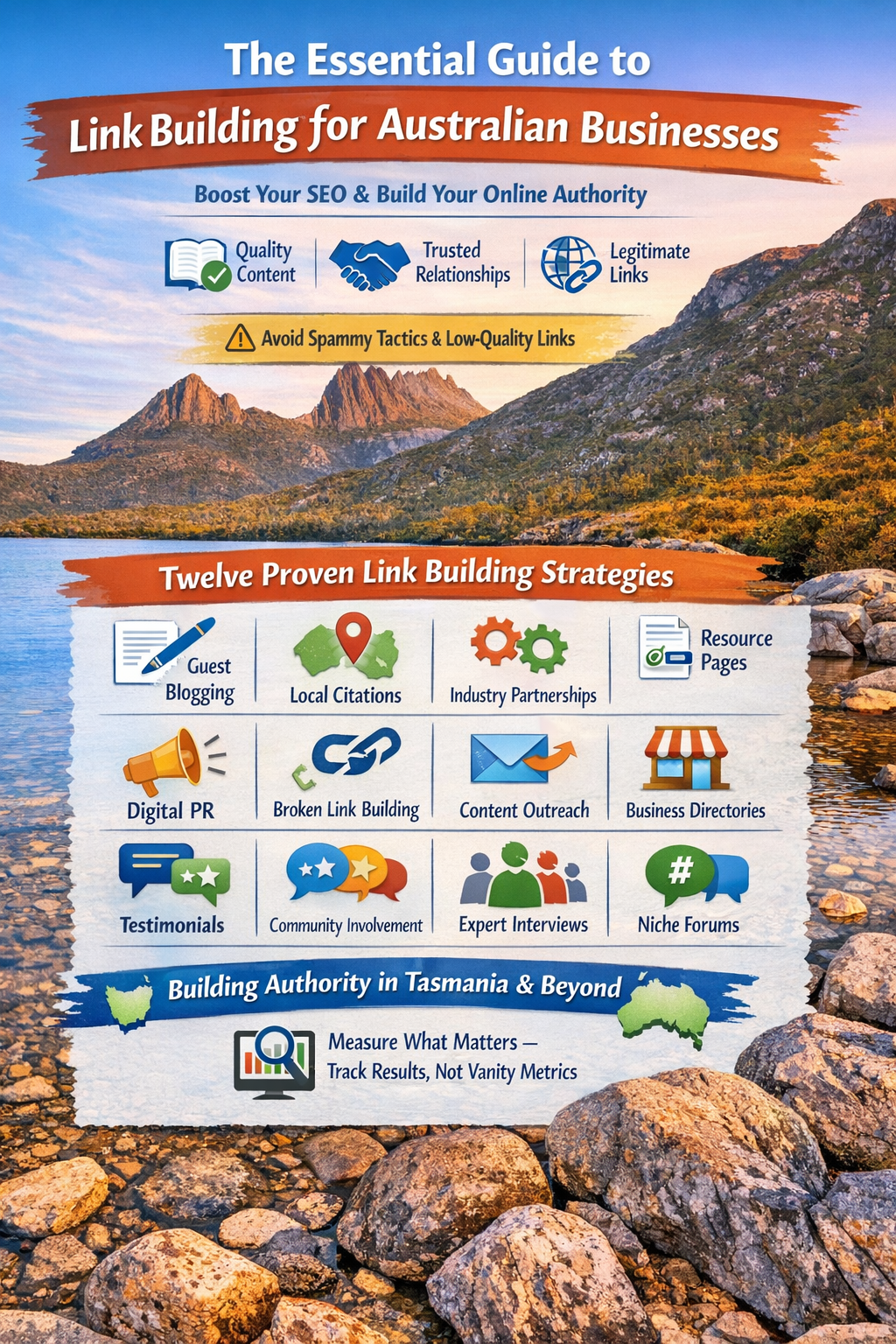
This guide explains 12 practical link building strategies, how to evaluate backlink opportunities, how local businesses can build authority in Tasmania and across Australia, and how to measure results without wasting money on vanity metrics.
Quick Answer: What Is the Best Way to Build Links for SEO?
The most sustainable approach is to earn editorial backlinks from relevant websites that have genuine audiences and a legitimate reason to reference your content or business.
For most small businesses, a sensible starting strategy combines:
Reclaiming lost backlinks and correcting broken destination pages.
Earning mentions from genuine suppliers, customers and business partners.
Publishing original guides, research or useful resources.
Building relationships with relevant local and industry organisations.
Contributing expertise to legitimate publications.
Supporting important service pages through strategic internal linking.
The strongest approach depends on your business, competitors, existing reputation and commercial priorities.
The objective is not to collect links. It is to create relevant visibility that contributes to enquiries, bookings, sales and long-term business value.
What Is Link Building in SEO?
Link building is an off-page SEO activity focused on acquiring hyperlinks from external websites.
When another website links to yours, it creates a path that users and search engine crawlers may follow.
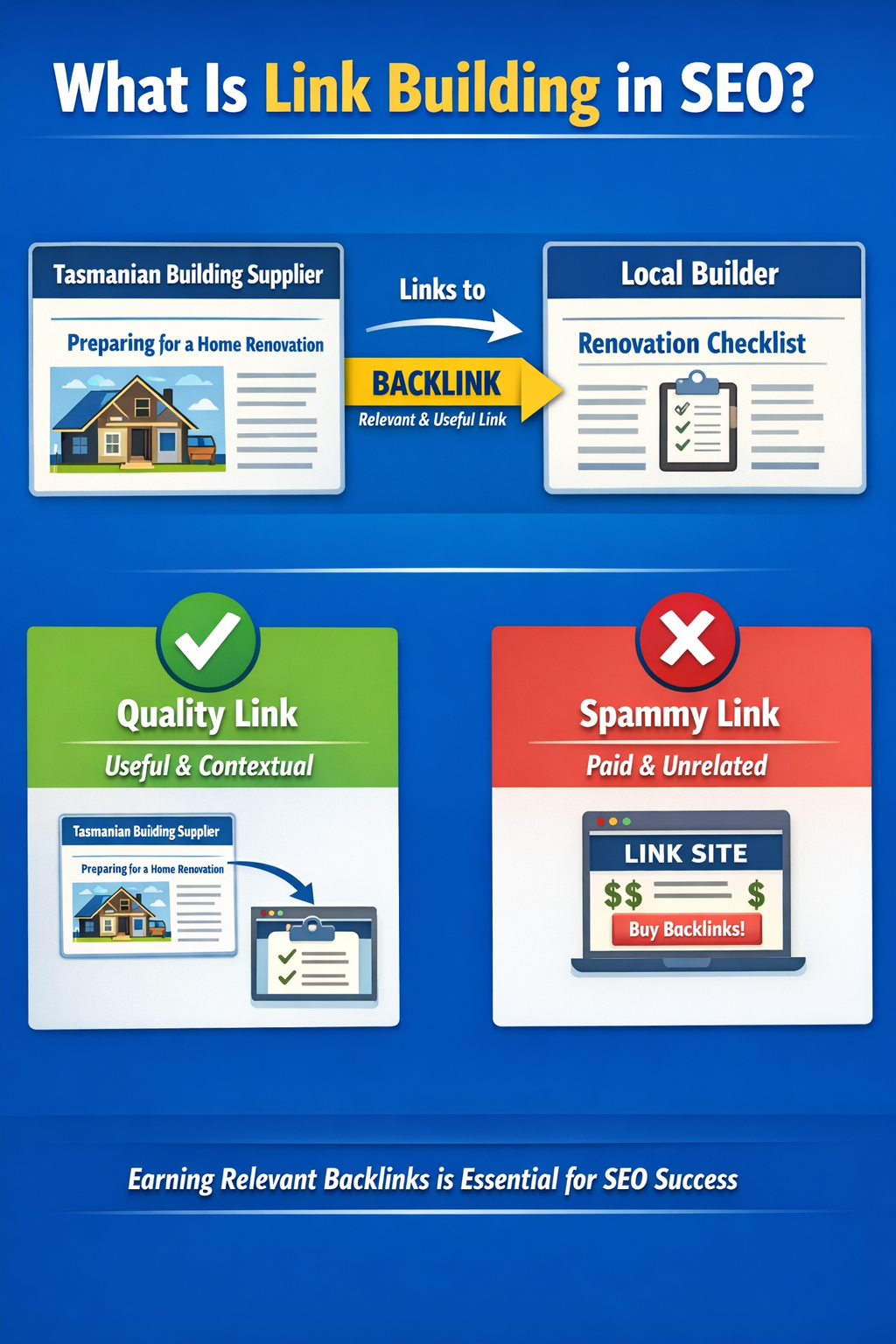
For example, imagine a Tasmanian building supplier publishes an article about preparing for a home renovation. The article references a local builder’s detailed renovation checklist.
That reference creates a backlink to the builder’s website.
The link is contextually relevant because the supplier’s audience may genuinely benefit from the builder’s information.
This is different from obtaining an unrelated link on a website created primarily to sell backlink placements.
Backlinks versus internal links versus local citations
These three concepts are related but not interchangeable.
| Link type | Definition | Main purpose |
|---|---|---|
| Backlink | A link from another website to yours | Referral traffic, discovery and potential authority signals |
| Internal link | A link between pages on your website | Navigation, discovery and contextual relationships |
| Local citation | A business mention or listing containing identifying details | Business discovery and information consistency |
Some local citations contain backlinks. Others mention a business without linking to its website.
Similarly, internal links can support SEO without creating any new external backlinks.
Understanding these differences is essential when evaluating an SEO proposal or backlink report.
Why Do Backlinks Matter for Search Rankings?
Google uses links as one of many signals to understand pages and discover information.
Relevant links can provide context about a website and help search engines identify relationships between different sources.
But backlinks are not a substitute for helpful content, search intent alignment, technical accessibility or a usable website.
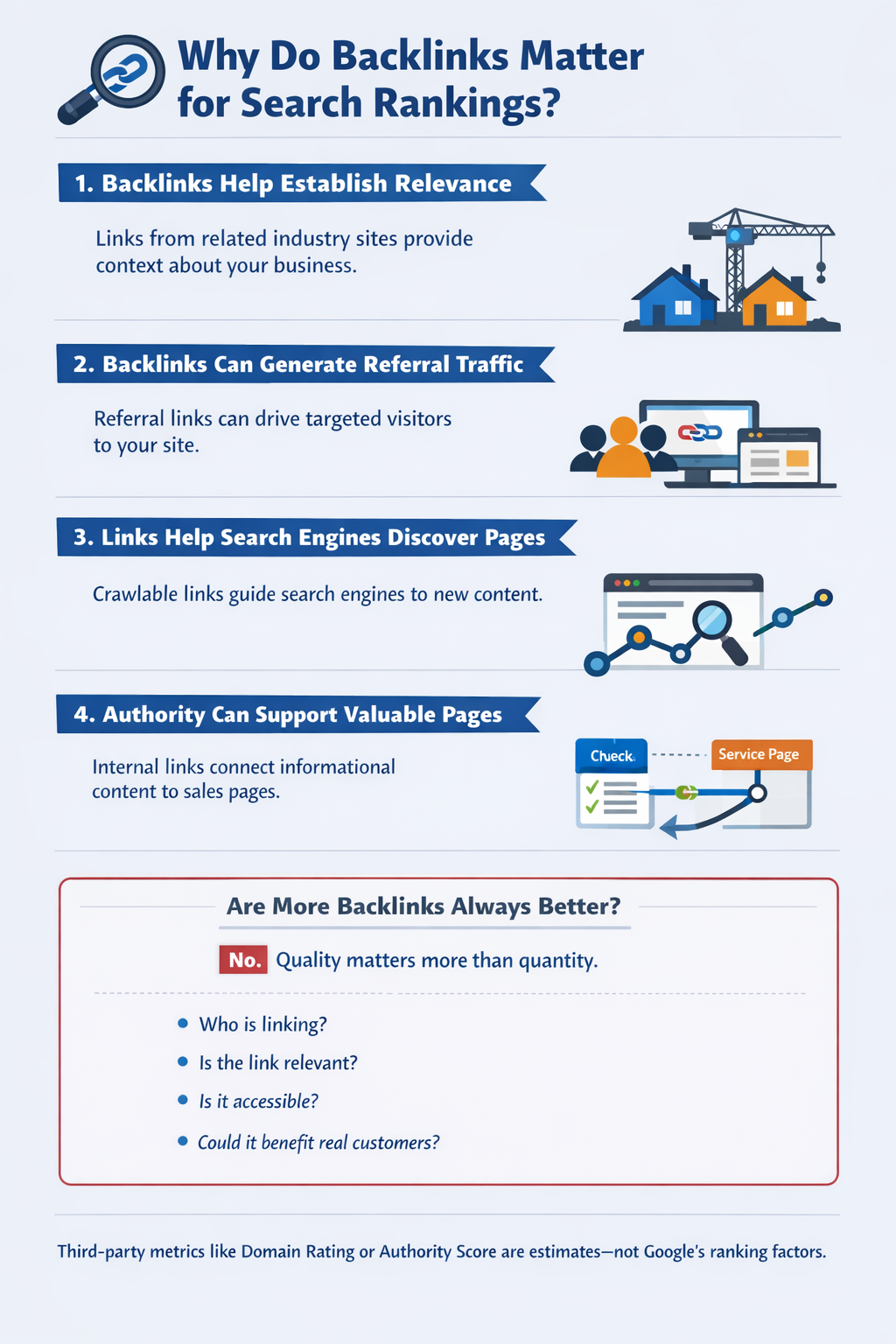
1. Backlinks help establish relevance
A business receiving genuine references from websites related to its industry provides contextual signals about what it does.
For example, links from relevant construction suppliers, building associations and renovation publications may be more meaningful to a building company than links from unrelated entertainment websites.
2. Backlinks can generate referral traffic
A link may attract potential customers directly, even if it has limited influence on rankings.
A mention in a publication read by your ideal customers could generate enquiries without the visitors ever searching Google.
3. Links help search engines discover pages
Crawlable hyperlinks provide routes through the web.
Links from established pages can help search engines discover useful resources that might otherwise receive little attention.
4. Authority can support commercially valuable pages
Many businesses find it easier to earn backlinks to educational resources than directly to sales pages.
Strategic internal linking connects those resources to relevant service pages, giving visitors a pathway from research to enquiry.
For example:
Helpful website launch checklist → Small business website design services → Request a quote
That is a more coherent strategy than obtaining backlinks to unrelated articles without considering how they support customer acquisition.
Are more backlinks always better?
No.
The number of backlinks is not a reliable standalone measure of SEO quality.
Evaluate who is linking, why the link exists, whether the page is relevant, how accessible the link is and whether the referral could be useful to real customers.
Third-party metrics such as Ahrefs Domain Rating or Semrush Authority Score can assist with research, but they are proprietary estimates—not Google’s ranking scores.
12 Effective Link Building Strategies
The following methods emphasise legitimate, commercially useful opportunities rather than mass backlink acquisition.
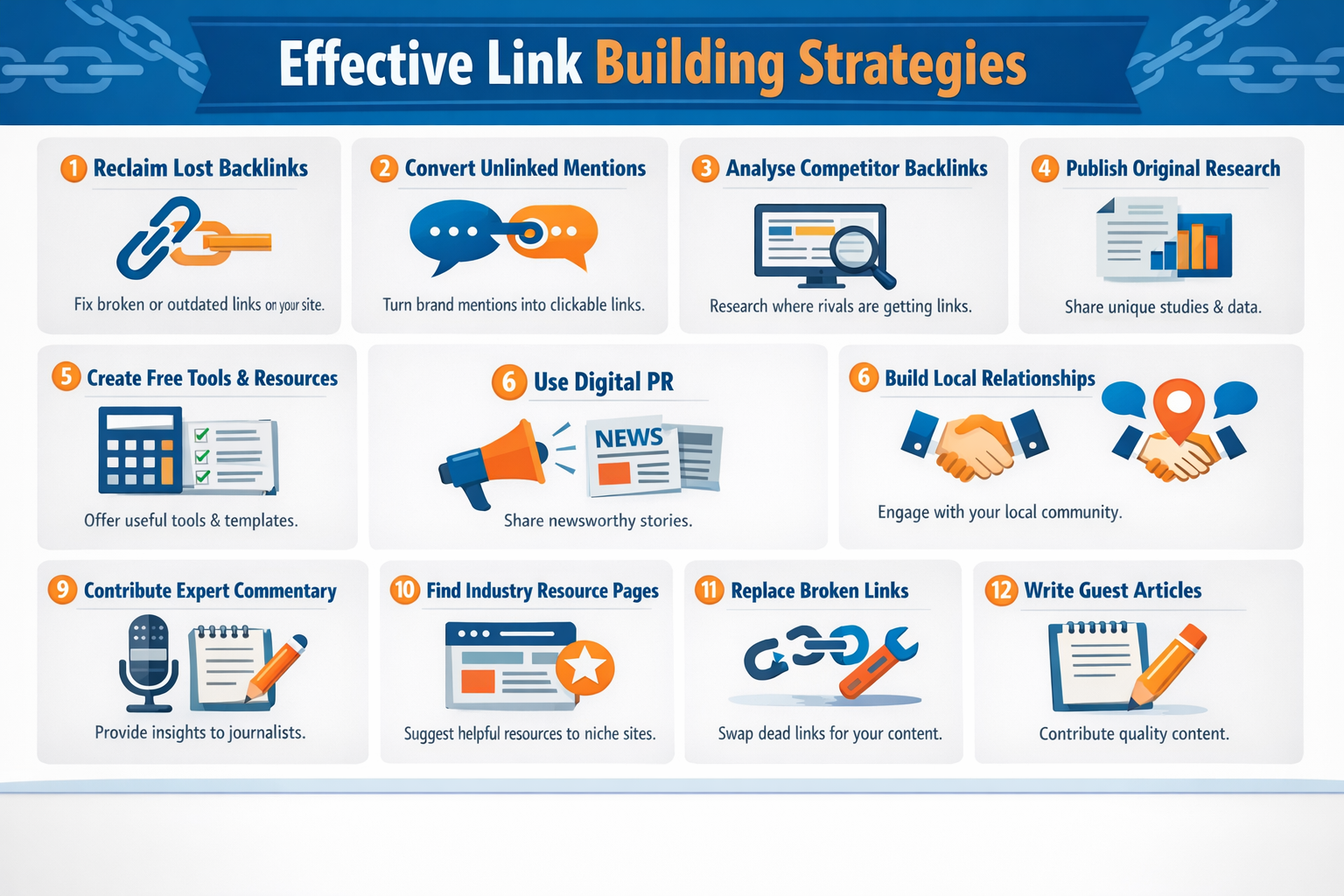
1. Reclaim Lost Backlinks Before Building New Ones
One of the most efficient starting points is recovering backlinks your website has already earned.
Links can lose value when pages are deleted, URLs change or other websites point to outdated addresses.
Start by reviewing your existing backlink profile.
Look for external links pointing to:
Pages returning 404 errors.
URLs removed during a website redesign.
Old product or service pages.
Incorrect domain versions.
Content moved to a new location.
Where a genuinely equivalent replacement exists, implement an appropriate permanent redirect.
If a valuable resource was accidentally removed, restoring the original content may be better.
Avoid redirecting every missing page to the homepage. Redirects should take visitors to relevant destinations.
Why prioritise this? You may be able to restore useful referral paths without persuading anyone to publish a new link.
2. Convert Unlinked Brand Mentions Into Useful Links
Sometimes another website references your company without including a clickable link.
These mentions may appear in news articles, business features, supplier pages or industry publications.
Search for your business name, product names and distinctive brand terms.
When a relevant mention appears, check whether linking to your website would genuinely help readers.
If it would, politely contact the publisher and suggest the appropriate destination.
For example:
“Thank you for mentioning our business in your article. If helpful to readers, our website contains further information about the project.”
Do not demand a link or insist on keyword-rich anchor text.
The publisher should retain editorial control.
3. Analyse Competitors’ Backlinks
Competitor backlink research can reveal publications, associations and resources that already reference businesses similar to yours.
Rather than copying an entire backlink profile, identify the legitimate relationships worth investigating.
For example, a Devonport business could examine the websites linking to comparable providers in Tasmania and mainland Australia.
Look for:
Industry associations.
Local business organisations.
Supplier directories.
Relevant editorial publications.
Specialist blogs.
Community resources.
Business event websites.
Tools such as Ahrefs and Semrush can help identify linking domains and compare competitors’ profiles.
However, a backlink gap does not automatically represent an opportunity.
Some competitor links may be paid, irrelevant, inaccessible or obtained through practices you should not imitate.
Useful question: Why did this publisher link to the competitor, and what legitimate reason would it have to reference our business?
4. Publish Original Research and Useful Business Data
Original information can give publishers a reason to reference your website.
Examples include:
An anonymised analysis of website performance across a defined sample.
A survey of common marketing problems facing regional businesses.
Research comparing website accessibility issues.
A breakdown of common website launch mistakes.
An original analysis of publicly available local business information.
The important requirement is genuine evidence.
If you publish a report, explain the methodology, sample size, collection period and limitations.
Avoid inventing statistics or presenting unverified estimates as research findings.
A smaller, carefully documented study can be more credible than a broad article filled with unsupported claims.
For businesses with access to appropriate first-party information, original research may become a repeatable source of useful editorial coverage.
5. Create Free Tools, Checklists and Calculators
Useful resources are often easier to reference than promotional pages.
Examples include:
Website launch checklists.
Website maintenance planning templates.
SEO audit worksheets.
Business website cost comparison calculators.
Local listing accuracy checklists.
Accessibility assessment guides.
For example, a business association writing about launching a new company website may have a legitimate reason to recommend a useful preparation checklist.
This can bring potential customers into contact with your brand before they are ready to purchase.
At VanBlaisa, our approach to website projects includes technical SEO foundations, mobile usability and conversion-focused planning.
You can explore examples of this work in our website design case studies.
The best resource is one that solves a genuine problem and remains useful without requiring readers to purchase anything.
6. Use Digital PR to Earn Editorial Coverage
Digital public relations involves sharing genuinely newsworthy information with relevant publishers.
Potential topics include:
Launching a meaningful new product or service.
Publishing original industry research.
Announcing a substantial partnership.
Reporting a verified business milestone.
Sharing an initiative with clear community benefit.
Offering informed commentary on an industry development.
For example, a Tasmanian software company releasing a genuinely useful business technology product may have a relevant story for technology and regional business publications.
The announcement needs a real news angle.
Simply distributing promotional text to hundreds of websites does not create an effective digital PR strategy.
Important distinction: A press release can increase awareness and generate coverage, but syndicated press-release links should not be treated as guaranteed ranking signals.
Google’s spam policies specifically address optimised links in distributed press releases when used to manipulate rankings.
Focus on earning independent editorial interest rather than inserting repeated keyword-rich links into press-release distribution networks.
7. Build Genuine Local Business Relationships
Local link building is particularly relevant to businesses serving specific geographic markets.
For businesses in Devonport, Burnie, Ulverstone, Latrobe, Launceston, Hobart or other Tasmanian communities, genuine local relationships can support visibility.
Potential opportunities include:
Relevant chambers of commerce.
Industry associations.
Business networking groups.
Community initiatives.
Local educational resources.
Regional events.
Partnerships with complementary providers.
The relationship should have value beyond obtaining a link.
For example, if a business participates in a legitimate industry event, an organiser’s page may naturally mention and link to participating businesses.
A local sponsorship can be commercially worthwhile for brand awareness, but sponsored placements should be disclosed and links appropriately qualified.
Do not create artificial relationships solely to manufacture search ranking signals.
8. Earn Relevant Supplier and Customer References
Businesses often have established relationships that can support credible online mentions.
Consider suppliers, implementation partners or customers who may genuinely benefit from referencing your work.
Appropriate examples include:
A supplier describing a completed integration.
A customer publishing a genuine project case study.
A partner referencing jointly developed educational material.
An industry organisation acknowledging a legitimate contribution.
For instance, a software integration case study may naturally reference both the software provider and the business implementing the solution.
These links are valuable because they help users verify the relationship and understand what was delivered.
Avoid making keyword-rich links compulsory in contracts or arranging excessive reciprocal linking.
Where compensation or other material consideration is involved, follow applicable disclosure rules and search engine link policies.
9. Contribute Expert Commentary to Journalists
Journalists and industry writers sometimes need informed perspectives from practitioners.
Relevant opportunities may include commentary on:
Website security risks.
Small business digital adoption.
Search and AI technology changes.
Online customer behaviour.
Digital accessibility.
Business automation.
Website ownership and vendor lock-in.
A useful contribution should be accurate, relevant and supported by actual professional knowledge.
Do not fabricate qualifications, project results or personal experiences.
An expert mention may create value through exposure, reputation or referral traffic, whether or not the publication includes a conventional followed backlink.
A link should be a possible outcome of meaningful participation, not the sole reason for contributing.
10. Find Legitimate Industry Resource Pages
Some industry organisations and publishers maintain curated collections of helpful resources.
For example, an industry group might provide educational material for businesses preparing to launch an online store.
If your website contains an original resource that meaningfully helps that audience, you may have a legitimate reason to suggest it.
Before approaching a publisher, assess:
Whether the resource page is actively maintained.
Whether its audience matches your intended customers.
Whether your content offers something not already covered.
Whether the publisher uses genuine editorial selection.
Whether the page exists primarily to help readers rather than sell links.
Avoid submitting to mass-generated directories or pages containing hundreds of unrelated promotional links.
A useful resource placement should make sense to someone unfamiliar with SEO.
11. Replace Broken References With Better Resources
Broken link building involves identifying a reference on another website that no longer works and offering a relevant replacement.
For example, an industry guide may link to a discontinued business website checklist.
If your business has published an accurate, comprehensive alternative, the publisher might appreciate being informed about the broken reference.
A practical approach is to:
Find a genuinely relevant broken external link.
Check what the original destination contained.
Confirm your resource answers the same need.
Explain the issue to the publisher.
Suggest your resource only if it is a suitable replacement.
The goal is to improve an existing article for its readers.
Do not use fabricated broken-link reports or generic mass outreach.
12. Publish Selective Guest Contributions and Educational Content
A well-researched article written for a relevant publication can help establish expertise and reach new audiences.
Potential formats include:
Specialist guest articles.
Practical industry tutorials.
Expert interviews.
Podcast appearances.
Professional association educational resources.
Contributions to legitimate business publications.
Choose opportunities based on audience relevance, editorial standards and genuine expertise.
Avoid low-quality guest-post networks that publish large volumes of repetitive content with artificial anchor text.
If the article would have no meaningful value without an SEO backlink, reconsider the opportunity.
Client reviews
"Has seen my business grow daily..."
How to Evaluate a Backlink Opportunity Before Investing
A backlink opportunity should be assessed before spending time or money pursuing it.
To help small businesses make more disciplined decisions, the following VanBlaisa Link Opportunity Score provides a practical evaluation framework.
This is an editorial planning framework, not a Google ranking factor or a validated prediction of SEO performance.
The VanBlaisa Link Opportunity Score
Score each criterion from 1 to 5.
| Criterion | What to assess | Maximum |
|---|---|---|
| Topical relevance | Is the website genuinely connected to your industry or expertise? | 5 |
| Audience quality | Could its readers become customers, partners or useful referrers? | 5 |
| Editorial credibility | Does it publish legitimate, curated information? | 5 |
| Geographic or market fit | Does it reach a relevant service area or commercial market? | 5 |
| Commercial value versus effort | Is the potential benefit reasonable relative to the cost? | 5 |
| Total | A prioritisation score, not a ranking prediction | 25 |
Example assessment
Consider a hypothetical Devonport trades business evaluating three opportunities.
| Opportunity | Illustrative score | Assessment |
|---|---|---|
| Relevant industry association resource | 23/25 | High-priority opportunity |
| Legitimate regional business feature | 21/25 | Strong prospect |
| Unrelated generic directory | 7/25 | Low priority |
These scores are examples only; they do not represent assessments of real websites.
The commercial value of a potential link depends on the particular business, audience and cost.
Policy check comes first: Disqualify any opportunity involving manipulative link requirements or practices that violate search policies, regardless of its score.
A high-scoring paid advertisement is not a reason to disguise an advertising link as an editorial endorsement.
Local Link Building in Tasmania: A Practical Example
Imagine a small business providing residential landscaping services in Devonport and neighbouring communities.
Its goal is to attract qualified enquiries from property owners who need landscaping and ongoing garden maintenance.
A practical strategy could involve three connected activities.
Build a genuinely useful local resource
Publish an original guide covering seasonal garden maintenance considerations for North West Tasmanian conditions.
Include useful photographs, practical explanations and accurate recommendations.
Share the resource with relevant audiences
Identify local community groups, suppliers or industry organisations whose audiences could genuinely benefit.
Do not assume that every organisation will want to publish a link.
Focus on relationships and editorial usefulness.
Connect visitors to relevant services
Within the resource, link naturally to the business’s landscaping or garden maintenance service pages.
Those pages should explain service availability, project suitability and the process for requesting a quote.
The resulting journey is straightforward:
Useful local content → Relevant referral or search visit → Service information → Qualified enquiry
This is a more commercially coherent approach than acquiring unrelated backlinks and hoping they eventually generate traffic.
How Internal Linking Strengthens Your Link Building Strategy
External links and internal links should work together.
When an informative page earns relevant mentions or backlinks, internal links can help visitors discover related services.
For example, a website design company might publish a detailed article about preparing a business website.
That article could naturally link to its website development services, relevant case studies and contact information.
At VanBlaisa, useful examples include:
Our guide to choosing the right website design firm.
Each page serves a different purpose.
The educational content answers research questions. The service page explains the offering. The case studies show relevant work.
Together, they help visitors move from learning about a subject to evaluating a commercial solution.
Internal linking best practices
Use descriptive anchor text, link to genuinely related pages and ensure important pages are accessible through normal navigation.
Check that links resolve correctly and that important destination pages are indexable.
Avoid repeatedly using identical keyword-heavy anchor text or inserting links into unrelated paragraphs.
Google’s official link guidance recommends making links useful and understandable to people.
Link Building and GEO: Can Backlinks Improve AI Search Visibility?
Generative Engine Optimisation (GEO) refers to practices intended to improve how accurately and visibly a business or its content appears in AI-assisted search and answer systems.
These systems may include Google’s AI Overviews and AI Mode, as well as other AI-powered research and answer tools.
Links, citations, brand mentions and reliable references may contribute to the wider body of publicly accessible information about a company.
However, there is no universal backlink formula that guarantees AI recommendations or citations.
What should businesses prioritise?
Clear business identity: Use consistent business and brand names across your website and relevant external profiles.
Accurate descriptions: Make it easy to understand your services, products, expertise and geographic coverage.
Original, verifiable information: Publish useful research, explanations, resources and documented examples.
Independent references: Earn legitimate mentions from trustworthy organisations and publications.
Accessible website content: Ensure important pages can be crawled and their primary information is available in readable text.
Appropriate structured data: Use schema that accurately describes visible page content without inventing claims.
Google states that its AI search features rely on the established foundations of good SEO. There are no additional special technical requirements for inclusion beyond the relevant search eligibility rules.
See Google’s guidance on AI features and websites.
Can an unlinked brand mention help GEO?
A consistent, credible mention can contribute to public information about a business, but its effect on any particular AI system cannot be reliably assumed.
A traditional backlink, a brand mention and an AI-generated citation are distinct things.
Track them separately.
Avoid paying for fabricated endorsements or creating artificial mentions simply to influence AI-generated recommendations.
Link Building Mistakes That Can Waste Your SEO Budget
Buying large quantities of low-quality backlinks
Packages promising hundreds or thousands of links for a small fee should be treated with caution.
Such links may originate from irrelevant websites, automated networks or pages created primarily to manipulate rankings.
Treating Domain Rating as Google’s authority score
Metrics supplied by SEO platforms can be useful for comparisons but are not official Google scores.
A high third-party domain metric does not prove that a particular backlink will improve rankings.
Using excessive exact-match anchor text
Repeated phrases such as “best SEO agency Tasmania” across numerous external links may indicate an artificially controlled backlink profile.
Genuine publishers should choose natural, contextually appropriate wording.
Misusing press releases
Press releases are useful for genuine announcements and brand awareness.
They should not be used as vehicles for large-scale keyword-optimised backlink schemes.
Building links to weak landing pages
A backlink will not fix unclear messaging, broken contact forms or poor service descriptions.
Before promoting a page, make sure it provides a useful experience and an appropriate next step.
Disavowing every unfamiliar backlink
Not every low-quality or unfamiliar link requires intervention.
Google often ignores spammy links. The disavow process is intended for specific situations involving substantial unnatural links and relevant manual-action risk, not routine backlink housekeeping.
Review Google’s Search Console guidance before acting on suspicious links.
How Much Does Link Building Cost in Australia?
The cost depends on the strategy, required research, content development and outreach effort.
There is no universal price that reliably predicts backlink quality.
| Activity | Typical cost drivers | Commercial consideration |
|---|---|---|
| Backlink reclamation | Audit and technical repair time | Often worth checking first |
| Brand mention outreach | Research and communication | Usually relatively low complexity |
| Local relationship building | Memberships, networking and staff time | Can provide value beyond SEO |
| Original research | Data collection, analysis and publishing | Higher effort but potentially reusable |
| Digital PR | Research, editorial preparation and outreach | Outcomes are uncertain |
| Interactive tools | Development, testing and maintenance | Can become a long-term owned asset |
For a small business with limited resources, prioritise opportunities that are useful even if they generate no measurable ranking improvement.
A relevant industry relationship, useful referral, customer introduction or evergreen resource may still create commercial value.
By contrast, purchasing backlinks solely to influence rankings introduces policy risk and may deliver little lasting benefit.
How to Measure Link Building Results
A link building campaign should be evaluated against commercial goals rather than backlink counts alone.
Track these metrics
| Metric | What it tells you |
|---|---|
| Relevant referring domains | How many distinct appropriate websites reference you |
| Referral traffic | Whether people visit through external links |
| Organic search impressions | Whether relevant pages are appearing in searches |
| Organic search clicks | Whether search visibility translates into visits |
| Qualified enquiries | Whether visitors become genuine sales opportunities |
| Conversion rate | How effectively visitors take meaningful actions |
| Customer acquisition cost | How much you spend to acquire customers |
| Attributed revenue | Whether the activity contributes to actual sales |
Use Google Search Console to review discovered backlinks and search performance.
The Search Console Links report is not a complete inventory of every backlink, so treat it as one evidence source rather than a definitive backlink database.
Where appropriately configured, Google Analytics 4 can help measure referral traffic, enquiries and other conversion events.
A simple return-on-investment example
Suppose a hypothetical business spends $600 on legitimate content development and outreach.
If that campaign contributes three additional customers with $400 gross profit each, the attributable gross profit would be $1,200.
The simple illustrative return would be:
($1,200 − $600) ÷ $600 × 100 = 100%
This calculation is not an expected result or an SEO performance forecast.
Actual attribution may be uncertain, customers may arrive through multiple channels, and the costs of producing and maintaining assets must be included.
The point is to evaluate economic outcomes, not simply how many backlinks a report displays.
Your 90-Day Link Building Action Plan
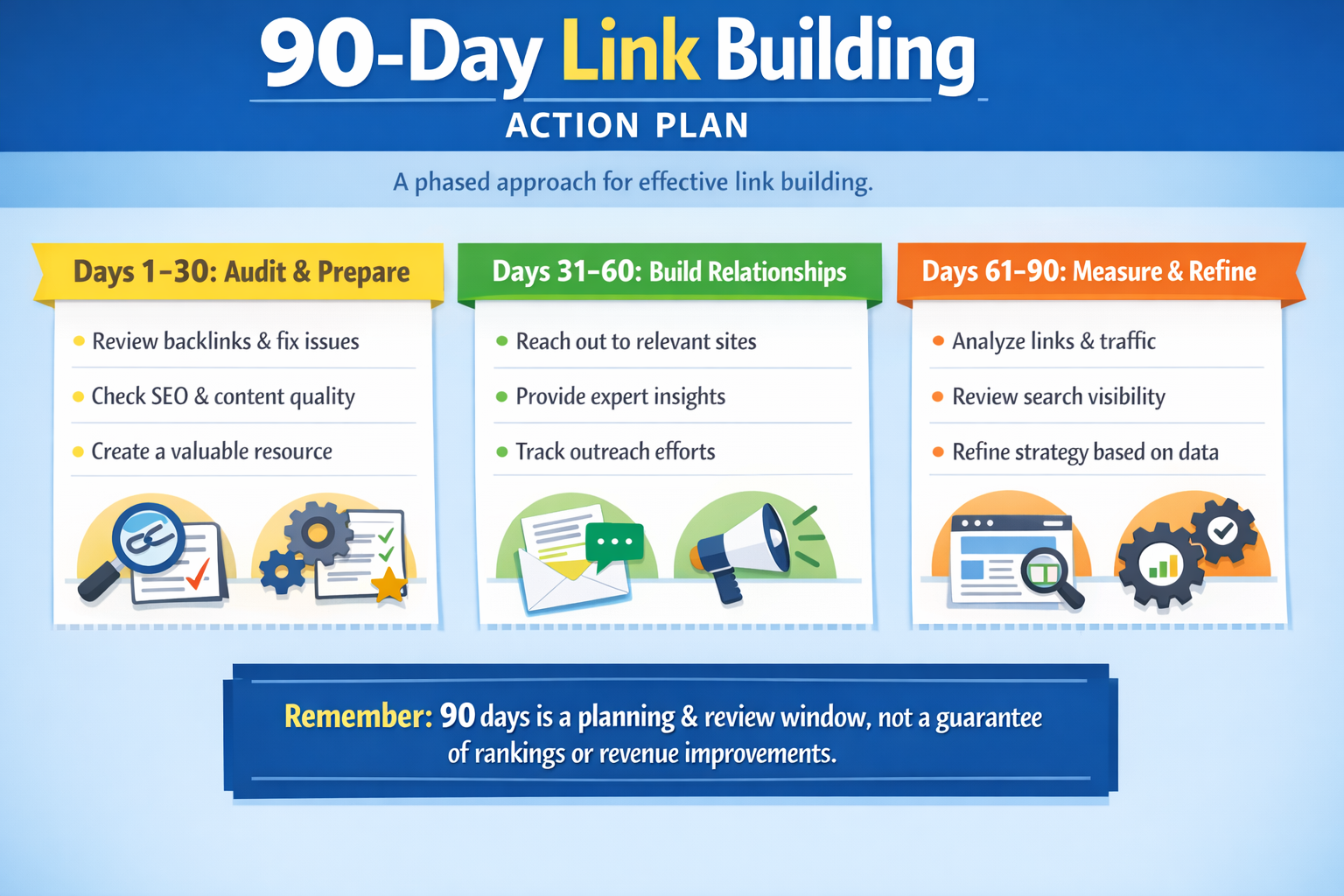
For businesses starting with limited time and resources, a phased approach is more manageable than attempting every tactic immediately.
Days 1–30: Audit and Prepare
Review existing backlinks, repair broken destination pages and identify important commercial landing pages.
Check technical SEO, content quality, internal links and conversion tracking.
Select a small number of legitimate backlink opportunities and create one genuinely useful resource.
Days 31–60: Build Relationships and Promote Resources
Contact relevant publishers, suppliers, business networks and industry organisations.
Provide useful information rather than generic link requests.
Explore opportunities for genuine expert commentary and editorial coverage.
Record each contact, the relevant content and the outcome.
Days 61–90: Measure and Refine
Review acquired mentions and links, relevant referral visits, changes in search visibility and qualified enquiries.
Check whether resources are helping visitors discover relevant commercial pages.
Refine the approach based on evidence rather than simply increasing outreach volume.
Remember: Ninety days is a planning and review window, not a guarantee of measurable ranking or revenue improvements.
Frequently Asked Questions About Link Building
What is link building for SEO?
Link building is the process of earning hyperlinks from external websites to your own. Relevant backlinks can help with website discovery, referral traffic and search engine evaluations of relevance and authority.
Are backlinks still important for SEO in 2026?
Yes. Links remain part of search engine ranking and discovery systems, but their usefulness depends on relevance, context and quality. Content, technical SEO and search intent also matter.
How many backlinks do I need to rank on Google?
There is no universal number. Competitive requirements differ by keyword, industry, location and website. A backlink count alone cannot predict rankings.
What is the difference between a backlink and an internal link?
A backlink originates from another website. An internal link connects pages on the same website. Both can help users discover content, but they serve different functions.
Can local backlinks improve local SEO?
Relevant local links and business mentions can support discovery and geographic relevance. They are not a guarantee of inclusion in local search results or Google’s map listings.
Should I buy backlinks?
Buying links that pass ranking credit for the purpose of manipulating rankings violates Google’s spam policies. Legitimate advertising and sponsorship links should be appropriately disclosed and qualified, such as with rel="sponsored".
Do directory listings help SEO?
Accurate listings on legitimate, relevant business directories may help customers discover your business and maintain consistent business information. Mass submission to low-quality directories is not an effective long-term link building strategy.
What is the safest link building strategy?
Prioritise genuine editorial references, useful resources, legitimate partnerships, accurate business information and relevant industry participation. Avoid manipulative schemes and artificial link networks.
How long does link building take to work?
Results vary. Some links can provide referral traffic soon after publication, while search ranking effects may be delayed, minimal or difficult to isolate. No fixed timeframe or improvement is guaranteed.
Can backlinks help a business appear in AI search results?
External references and brand mentions can contribute to a company’s public information footprint. However, individual backlinks do not guarantee mentions, recommendations or citations in AI-generated answers.
How do I find competitors’ backlinks?
SEO research platforms such as Ahrefs and Semrush can help identify domains linking to comparable websites. Assess each opportunity for relevance, legitimacy and audience value rather than copying every competitor link.
Is link building worth the investment for a small business?
It can be, particularly when it supports relevant traffic, useful industry relationships and customer acquisition. Start by ensuring your website’s content, technical foundations and conversion pathways are functioning properly.
Build Search Visibility That Creates Real Business Value
Link building should support a broader digital growth strategy.
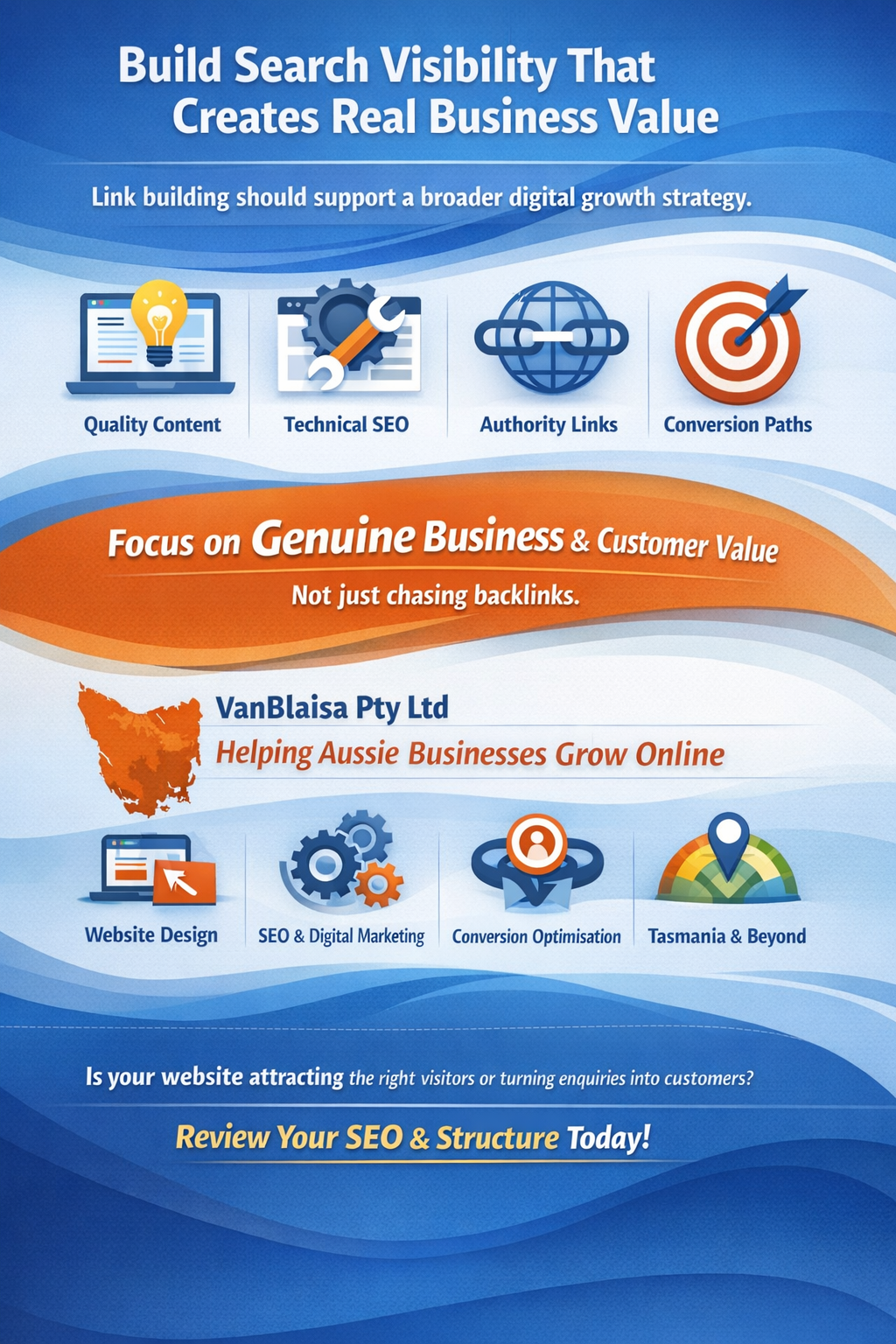
The most effective approach combines helpful website content, sound technical foundations, trustworthy external references and clear customer conversion pathways.
For Australian small businesses, this means prioritising relationships and resources that provide genuine commercial and customer value—not simply collecting backlinks to inflate a monthly report.
VanBlaisa Pty Ltd helps businesses strengthen their online presence through website design, search engine optimisation, digital marketing and conversion-focused website development.
Based in North West Tasmania, VanBlaisa works with businesses across Tasmania and Australia.
If your website is not attracting the right visitors or turning enquiries into customers, reviewing its SEO foundations and website structure is a practical starting point.
Explore our services: Website Design and Digital Services
See examples of our work: VanBlaisa Case Studies
Discuss your requirements: Contact VanBlaisa
Email: admin@vanblaisa.com
Phone: 0498 825 105
VanBlaisa Pty Ltd — Australian Website Design, SEO and Digital Technology.
Author: Richard Monssen, VanBlaisa Pty Ltd