Looking for a website design agency in Ulverstone? The right web designer should help your business attract relevant customers, build trust and convert website visits into enquiries, bookings or sales.
For businesses in Ulverstone, West Ulverstone and the surrounding Central Coast of Tasmania, a professional website is an important part of being found and chosen by local customers.
But an attractive website alone isn’t enough.
Your website needs to load quickly, work reliably on mobile devices, communicate your services clearly and make it easy for customers to contact you. It should also have the technical foundations needed to compete in relevant Google searches.
VanBlaisa Pty Ltd, based in West Ulverstone, provides website design, search engine optimisation (SEO), digital marketing and website support services for businesses across Tasmania and Australia.
This guide explains how to choose a website designer, identify problems with your current website, compare proposals and invest in a site designed around measurable business results.
What Should You Look for in an Ulverstone Website Design Agency?
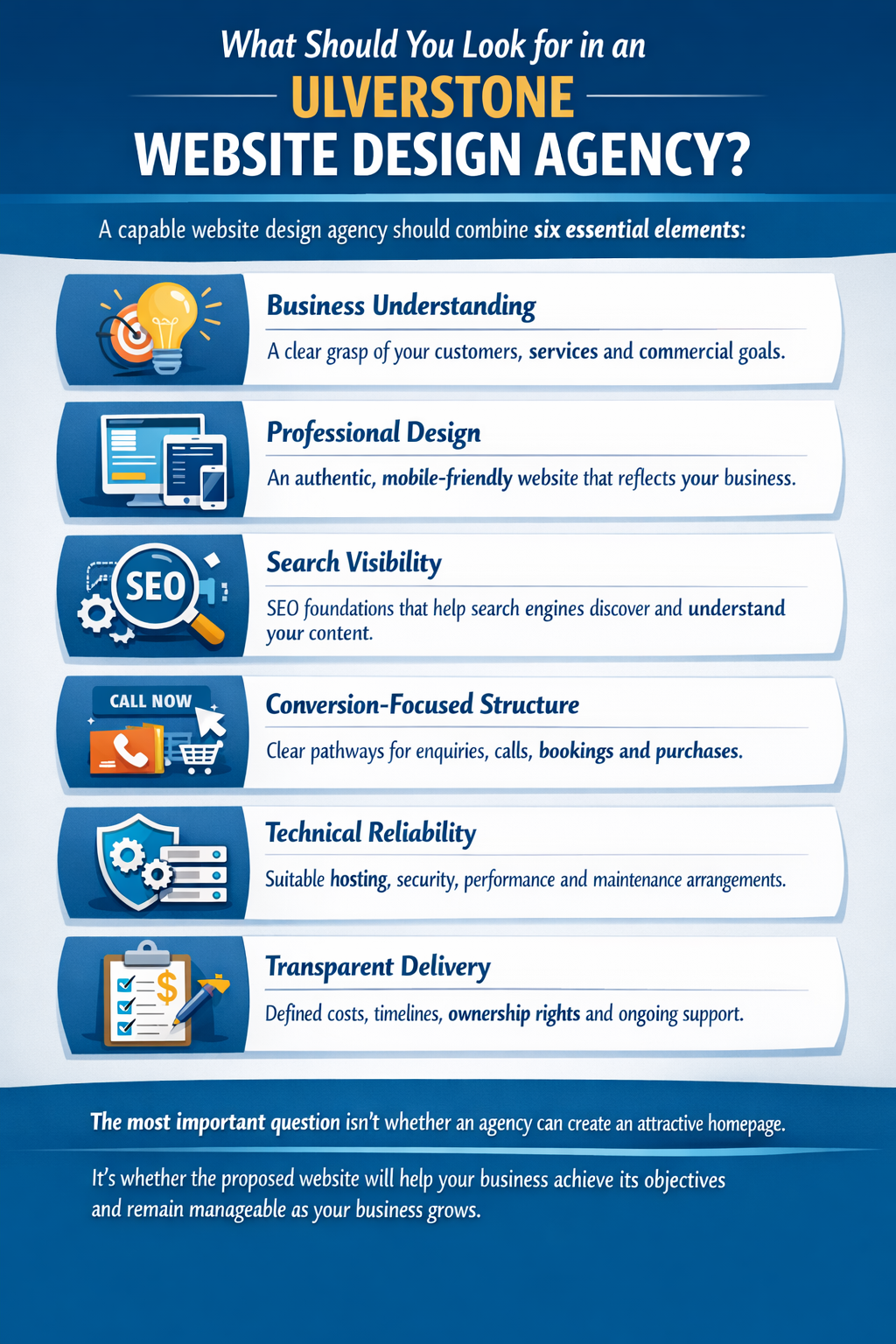
A capable website design agency should combine six essential elements:
- Business understanding: A clear grasp of your customers, services and commercial goals.
- Professional design: An authentic, mobile-friendly website that reflects your business.
- Search visibility: SEO foundations that help search engines discover and understand your content.
- Conversion-focused structure: Clear pathways for enquiries, calls, bookings and purchases.
- Technical reliability: Suitable hosting, security, performance and maintenance arrangements.
- Transparent delivery: Defined costs, timelines, ownership rights and ongoing support.
The most important question isn’t whether an agency can create an attractive homepage.
It’s whether the proposed website will help your business achieve its objectives and remain manageable as your business grows.
Why Local Website Design Matters for Ulverstone Businesses
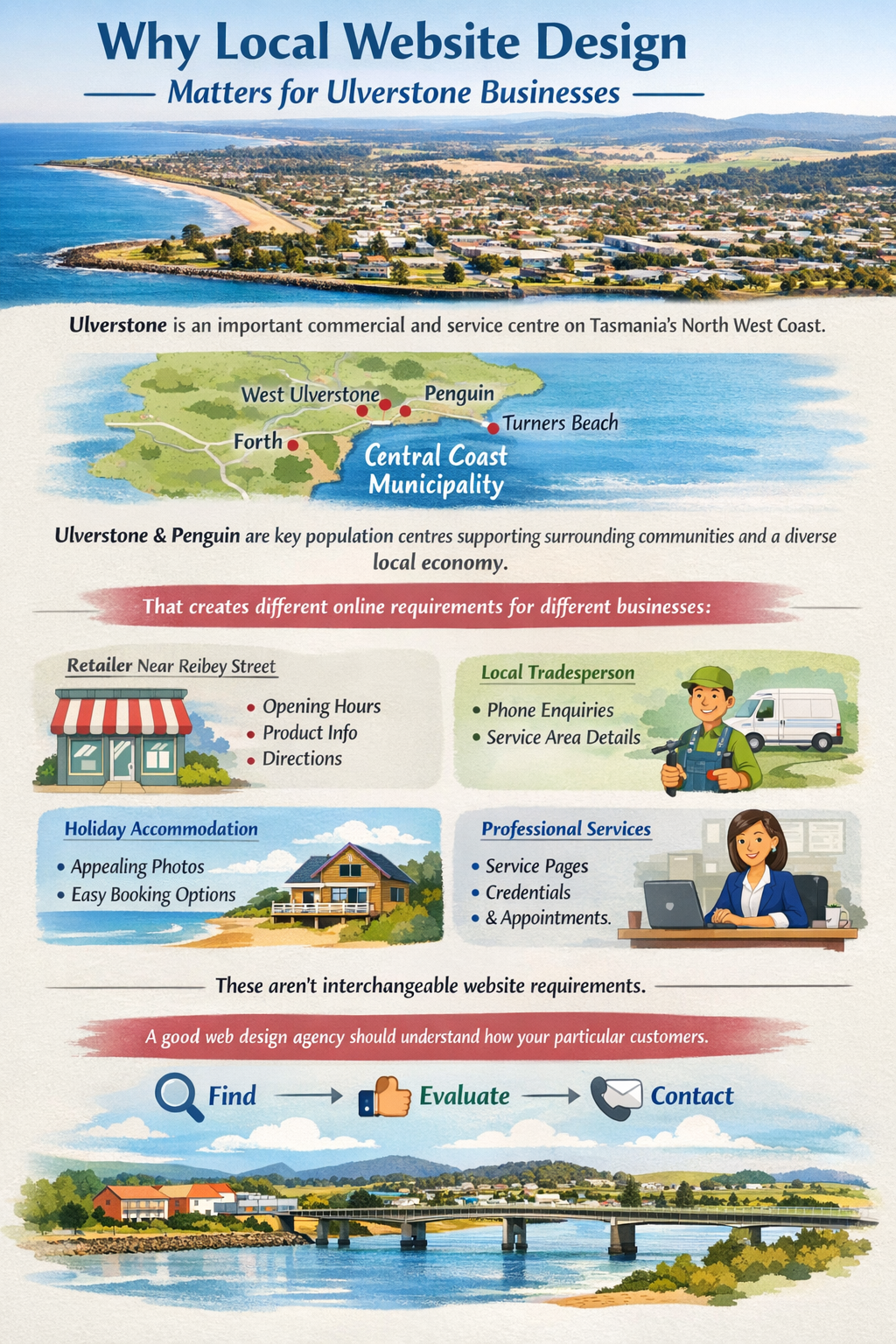
Ulverstone is an important commercial and service centre on Tasmania’s North West Coast.
The wider Central Coast municipality includes communities such as West Ulverstone, Penguin, Turners Beach, Forth, Gawler and surrounding rural areas.
According to Central Coast Council, Ulverstone and Penguin are the municipality’s principal population centres, supporting surrounding communities and a diverse local economy.
That creates different online requirements for different businesses.
A retailer near Reibey Street may need accurate opening hours, product information and directions.
A tradesperson servicing Ulverstone and Penguin may prioritise phone enquiries and service-area information.
A holiday accommodation provider may need appealing photography, accommodation details and straightforward booking options.
A professional services business may require detailed service pages, relevant credentials and clear appointment pathways.
These aren’t interchangeable website requirements.
A good web design agency should understand how your particular customers find, evaluate and contact your business.
Local knowledge should support real customer needs
An agency familiar with North West Tasmania may better understand local geography, business conditions and customer expectations.
However, location alone does not establish competence.
Evaluate the provider’s actual experience, technical capability, communication and project delivery.
A local designer who understands your business can be valuable, but a good proposal still needs measurable deliverables.
Is Your Current Website Losing Potential Customers?
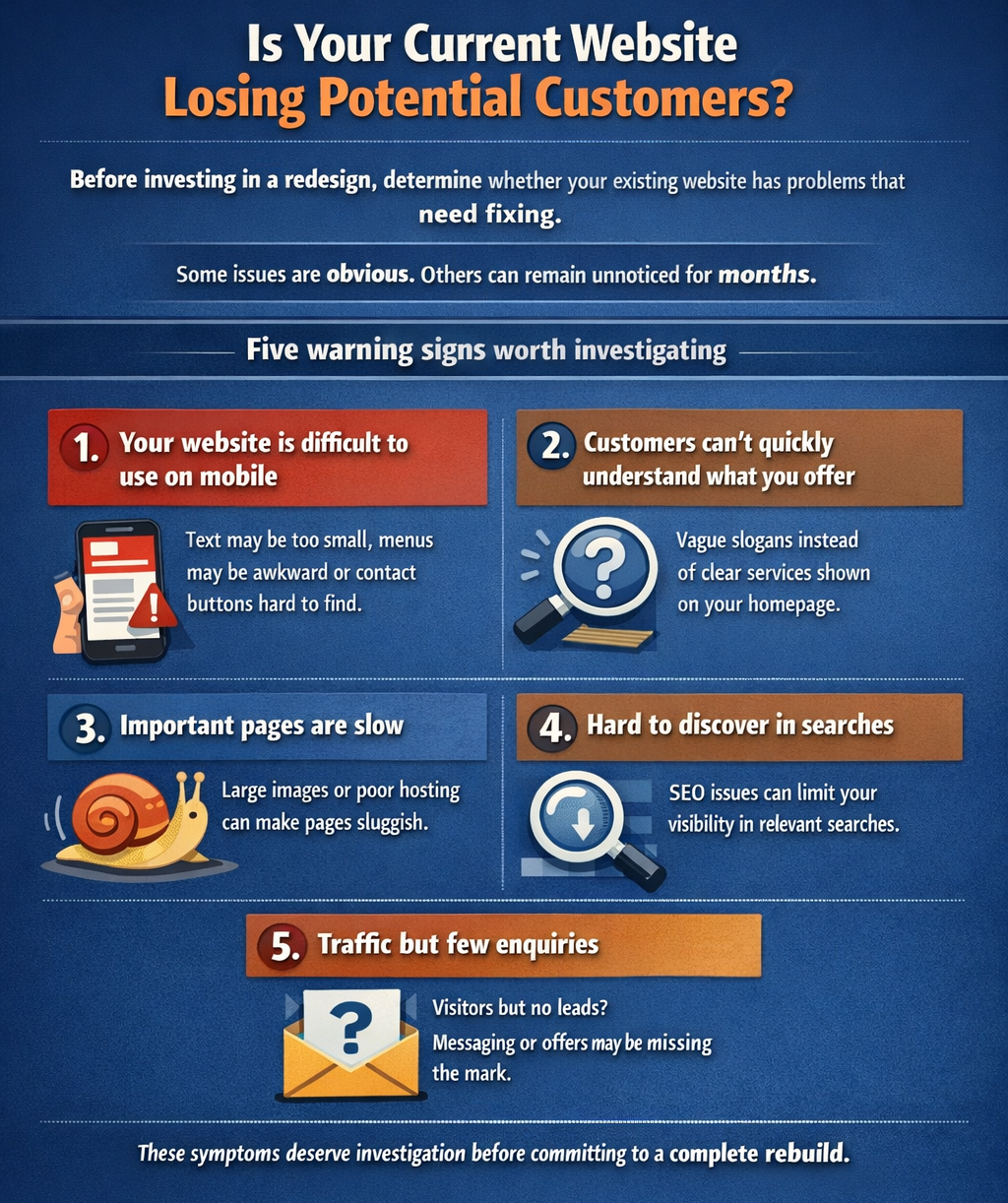
Before investing in a redesign, determine whether your existing website has problems that need fixing.
Some issues are obvious. Others can remain unnoticed for months.
Five warning signs worth investigating
1. Your website is difficult to use on mobile
Text may be too small, menus may be awkward or important contact buttons may be difficult to find.
2. Customers can’t quickly understand what you offer
Your homepage might emphasise vague slogans rather than explaining your services and who you help.
3. Important pages are slow
Large images, unnecessary scripts or inefficient hosting can make pages feel unresponsive.
4. Your business is difficult to discover through relevant searches
Poor website architecture, missing service content or technical indexing problems can limit visibility.
5. You receive website visits but few useful enquiries
This may indicate unclear messaging, weak offers, poor contact pathways or a mismatch between visitor intent and page content.
These symptoms deserve investigation before committing to a complete rebuild.
A practical 10-minute website self-assessment
Open your existing website on your phone and attempt the following tasks.
| Test | What to check |
|---|---|
| First impression | Can you identify the business and its main service immediately? |
| Local relevance | Is the operating location or service area clear? |
| Navigation | Can you reach an important service page in a few taps? |
| Contact | Can you call, book or submit an enquiry easily? |
| Credibility | Are genuine examples, qualifications or business details available? |
| Mobile usability | Are text, menus and forms readable and usable? |
| Performance | Does the page respond promptly without unexpected movement? |
| Search visibility | Can you find important pages through an appropriate branded search? |
Use Google PageSpeed Insights to investigate loading performance.
For indexing information, use Google Search Console if you have access to the website property.
These checks won’t replace a comprehensive audit, but they can reveal problems worth discussing with a designer.
Should You Repair Your Website or Build a New One?
One of the most expensive mistakes businesses can make is replacing an entire website when targeted improvements would solve the actual problem.
A redesign may be justified, but it should not be the automatic answer.
| Website situation | Potentially suitable approach |
|---|---|
| Slow images and excessive scripts | Targeted performance optimisation |
| Poor contact form or unclear calls to action | Conversion-focused improvements |
| Weak service content | Content restructuring and SEO updates |
| Outdated appearance but sound functionality | Visual refresh |
| Inflexible platform or major technical limitations | Consider a rebuild |
| Serious structural problems across the website | Evaluate a comprehensive redevelopment |
An existing website may have search visibility, backlinks, established content and customer recognition worth preserving.
If a rebuild is necessary, important pages, redirects, analytics and business functionality should be considered before launch.
Ask your agency to explain why it recommends a particular approach—and which existing assets will be preserved.
1. Make Local SEO Part of Your Website Strategy
Search engine optimisation is especially important for businesses serving identifiable communities.
When people search for services in Ulverstone, they may also be considering providers from nearby towns, depending on the service and how far they are willing to travel.
Your website should communicate genuine geographic relevance.
What local SEO involves
Clear service information
Important services should have useful descriptions that explain what is provided, who it suits and how customers can enquire.
Accurate geographic coverage
Describe the locations your business genuinely serves.
Consistent contact information
Business names, phone numbers and relevant location details should be accurate across your website and legitimate business listings.
Google Business Profile
Eligible businesses can use Google Business Profile to present relevant information in Google Search and Maps.
Structured data
Appropriate Schema.org markup can help search engines interpret business details and website content.
Useful local references
Relevant industry relationships, genuine customer reviews and credible local mentions can support discoverability and trust.
Do you need separate pages for Ulverstone, Penguin and Turners Beach?
Not automatically.
A business operating throughout the Central Coast may be better served by a strong primary service page and accurate service-area information.
Separate pages become useful when they contain meaningful differences, such as distinct services, locations, facilities or customer requirements.
Avoid duplicating pages and substituting town names purely to target additional searches.
What about AI search and GEO?
Generative Engine Optimisation (GEO) focuses on making information about your business clear, accessible and useful to AI-assisted discovery systems.
For a local business, the foundations include consistent business identity, accurate services, helpful content, credible references and crawlable pages.
AI systems may use different sources and retrieval methods, so no agency can guarantee inclusion in AI-generated answers.
Google’s guidance on AI features and websites reinforces the importance of established SEO practices rather than special AI-only markup.
A website should provide clear, factual answers that help both customers and search systems understand the business.
2. Look for Mobile-First, Fast and Accessible Design
Your website must work for customers using different devices, browsers and connection conditions.
Mobile-first design means planning for smaller screens and touch interactions rather than simply shrinking a desktop layout.
Features that make mobile websites easier to use
- Readable text without zooming.
- Clear menus and navigation.
- Easily accessible phone and contact links.
- Buttons with suitable spacing.
- Appropriately sized images.
- Simple enquiry forms.
- Minimal unnecessary animations.
- Logical content order.
Website performance also matters.
Google’s Core Web Vitals measure loading, responsiveness and visual stability.
| Metric | Good threshold |
|---|---|
| Largest Contentful Paint (LCP) | 2.5 seconds or less |
| Interaction to Next Paint (INP) | 200 milliseconds or less |
| Cumulative Layout Shift (CLS) | 0.1 or less |
Ask how the website designer evaluates these metrics and whether performance testing is included.
A good PageSpeed score does not guarantee higher rankings or more sales. It should be considered alongside real usability and conversion results.
Accessibility matters too. Websites should be designed with readable text, appropriate contrast, labelled forms and navigation usable by people with different abilities.
3. Choose Conversion-Focused Design Over Decoration
Website visitors generally want to accomplish something.
They may want a phone number, a quote, a booking or enough information to decide whether your business is suitable.
Conversion-focused design helps them complete that task.
Example: A local electrical business
Imagine a customer searching for an electrician servicing Ulverstone.
The first website opens with a large photograph and a slogan but provides little information about services or operating areas.
The second clearly explains its electrical services, identifies its actual coverage, displays relevant qualifications and provides an easy-to-use enquiry button.
The second website reduces the work required to make contact.
That doesn’t guarantee a sale, but it removes several common obstacles.
What effective conversion design includes
- A clear main offer.
- Descriptions written around customer needs.
- Genuine trust signals.
- Appropriate calls to action.
- Short, usable forms.
- Relevant FAQs.
- Visible contact options.
- Minimal unnecessary distractions.
Different businesses need different conversion paths.
A tradesperson might prioritise phone calls. A holiday accommodation provider might prioritise confirmed bookings. An online retailer needs a reliable checkout.
For more practical examples, read our guide to website design strategies that convert visitors into customers.
4. Ask for a Transparent Website Development Process
Before agreeing to a website project, establish what the agency will actually deliver.
A structured project reduces misunderstandings and makes it easier to identify problems before launch.
Discovery and planning
The provider should identify your business goals, ideal customers, service requirements and existing website assets.
Expected output: A clear brief and agreed scope.
Website structure and design
The agency plans navigation, priority pages, visual presentation and content.
Expected output: An agreed sitemap and design direction.
Development and integrations
The website is built and any agreed systems are configured.
These may include forms, online booking, e-commerce, analytics or business software.
Expected output: A functional website ready for testing.
Quality assurance
The agency checks important user journeys, responsive behaviour, performance and technical settings.
Expected output: Tested functionality and a clear defect-resolution process.
Launch and handover
The website is published and the agreed accounts, permissions and documentation are provided.
Expected output: A working website with defined operational responsibilities.
An uncomplicated business website doesn’t need excessive bureaucracy. It does need clear deliverables, responsibilities and acceptance criteria.
5. Know What Your Website Quote Includes
Website design costs depend on scope, complexity and ongoing requirements.
A basic brochure website is different from a custom online store or a platform with complex booking and automation workflows.
Rather than comparing headline prices alone, request an itemised proposal.
Essential questions about pricing
| Question | Why it matters |
|---|---|
| How many pages are included? | Establishes the scope |
| Who writes the content? | Avoids unexpected copywriting costs |
| What SEO work is included? | Distinguishes basic setup from broader optimisation |
| Are hosting and licences included? | Identifies recurring expenses |
| Are revisions included? | Clarifies change limits |
| What maintenance is provided? | Defines post-launch responsibilities |
| What happens if I change providers? | Reveals migration costs and restrictions |
One-off builds versus ongoing website packages
A fixed-price build may suit a business with an existing hosting and maintenance arrangement.
A managed monthly service may suit an owner who prefers the technical work to be handled for them.
Neither model is inherently better.
Consider total costs over the expected life of the website, not just the initial payment.
Commercial tip: Ask whether the provider can explain how the investment supports your customer acquisition or operational objectives.
A cheaper website that cannot deliver essential functionality may prove more expensive than a properly scoped project.
Equally, an expensive website does not automatically deliver better business results.
6. Protect Your Domain, Website and Customer Data
Your website is a business asset.
Before signing a contract, understand who controls its essential components.
These include:
- Your domain registration.
- DNS and hosting accounts.
- Website content and original images.
- Administrator access.
- Google Analytics and Search Console.
- Customer enquiry data.
- Relevant licences and subscriptions.
- Backups and recovery procedures.
Ownership of custom code, design files and third-party software depends on contractual terms and licensing arrangements.
Ask what happens if you change providers.
Can you export your content?
Can the website be migrated?
Are there cancellation or transfer charges?
Who retains access to your customer information?
A transparent agency should be able to explain these arrangements before the project begins.
7. Check the Agency’s Actual Work and Support Arrangements
A polished portfolio is useful, but it does not prove that every website delivers good outcomes.
Review live projects where possible.
Ask what the client needed, how the solution was developed and what technical or commercial improvements were measured.
What to inspect
Mobile experience: Does the website work well on phones?
Navigation: Can customers easily find services and contact information?
SEO structure: Are important pages organised logically?
Performance: Do key pages load and respond appropriately?
Content quality: Is the writing useful, specific and accurate?
Support arrangements: Who handles updates, backups, defects and future changes?
Examples of VanBlaisa website development work
VanBlaisa’s published website design case studies include:
O’Dea Lawyers: A multi-service law firm website upgrade focusing on service organisation, clearer customer pathways and SEO foundations.
Awkar & Co: A family law website rebuild involving service architecture, mobile usability and conversion-focused pages.
NSA Conveyancing: Service-led content organisation, internal linking foundations and website structures designed to help customers find relevant information.
These examples demonstrate aspects of website design and development worth evaluating.
Always distinguish implemented features from verified improvements in rankings, leads or revenue.
Questions to Ask an Ulverstone Website Designer Before Hiring
Use the following checklist during a discovery call.
- What would you recommend for my business, and why? Look for an answer grounded in your requirements.
- Can you show relevant live projects? Ask what challenges were solved and what evidence is available.
- What SEO work is included? Request specific deliverables rather than general promises.
- How will you improve the mobile experience? Ask about actual testing.
- What platform will you use? Understand the trade-offs and ongoing maintenance needs.
- Who owns or controls the website assets? Confirm access and transfer arrangements.
- What happens after launch? Establish support, maintenance and reporting responsibilities.
- How will we know whether the project succeeded? Agree on meaningful business metrics.
Warning signs to investigate
Be cautious when a proposal contains guaranteed first-place rankings, vague deliverables, hidden ongoing charges or unclear ownership terms.
A lack of relevant work examples or reluctance to explain technical decisions can also warrant further questions.
Don’t assume that a low price, high price or impressive portfolio alone establishes quality.
A good agency should be willing to explain its recommendations and responsibilities.
What Results Should You Measure After Launch?
Launching a new website is an important milestone, but its business value needs to be evaluated over time.
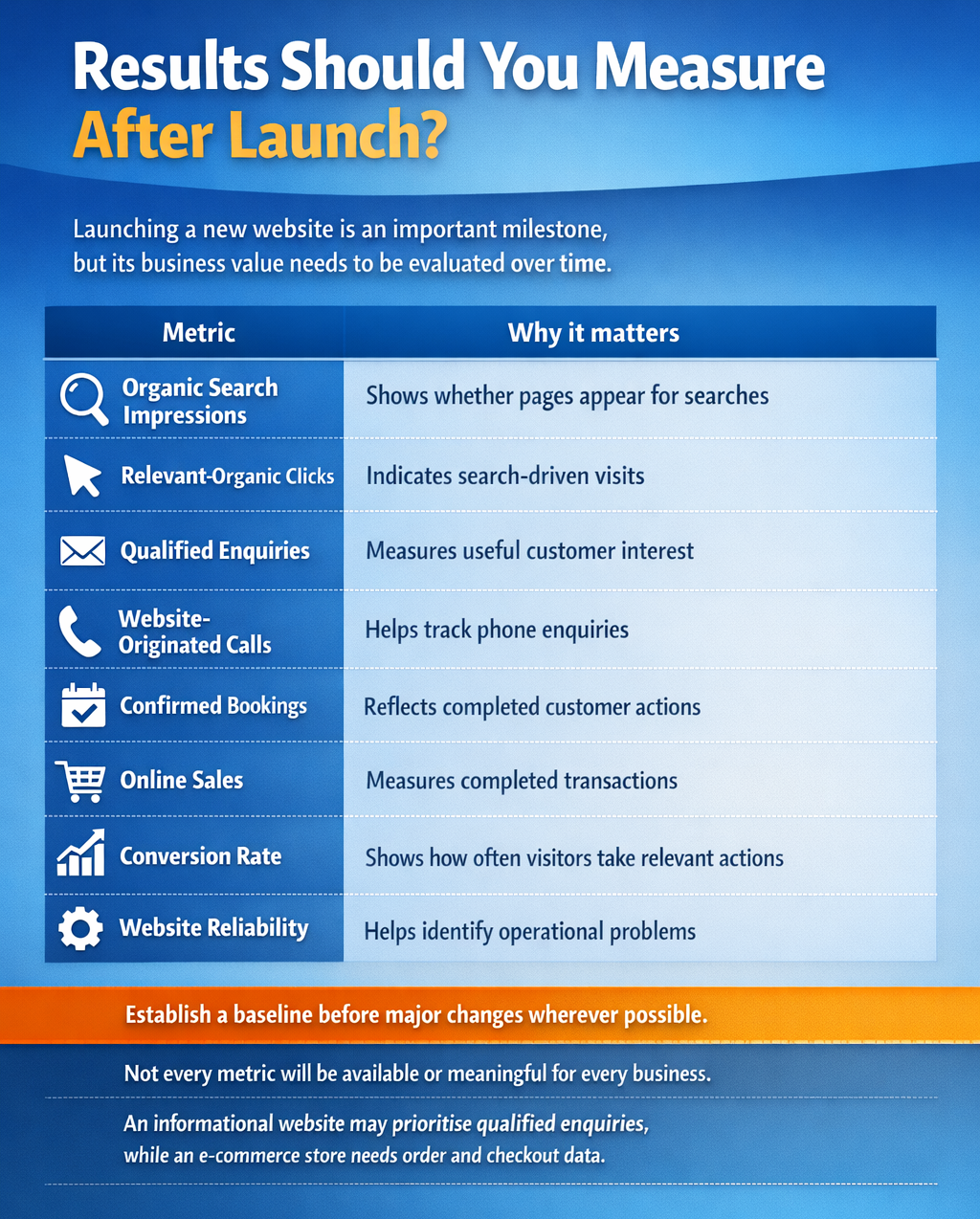
Relevant measurements may include:
| Metric | Why it matters |
|---|---|
| Organic search impressions | Shows whether pages appear for searches |
| Relevant organic clicks | Indicates search-driven visits |
| Qualified enquiries | Measures useful customer interest |
| Website-originated calls | Helps track phone enquiries |
| Confirmed bookings | Reflects completed customer actions |
| Online sales | Measures completed transactions |
| Conversion rate | Shows how often visitors take relevant actions |
| Website reliability | Helps identify operational problems |
Establish a baseline before major changes wherever possible.
Not every metric will be available or meaningful for every business.
An informational website may prioritise qualified enquiries, while an e-commerce store needs order and checkout data.
Review results without chasing unnecessary changes
During the first few months, prioritise technical reliability, working contact paths, accurate analytics and important usability problems.
Use actual data to identify further improvements.
SEO results may take time to develop, especially for new websites and competitive searches.
A website should be maintained and improved as necessary, not redesigned continuously without evidence that the changes will help.
For more about turning visitors into customers, explore our guide to local business lead generation.
Frequently Asked Questions About Website Design in Ulverstone
Is there a website design agency based near Ulverstone?
Yes. VanBlaisa Pty Ltd is based in West Ulverstone, Tasmania, and provides website design, SEO, digital marketing and website support services. Other providers also operate in or serve the Ulverstone area. Compare relevant experience, deliverables and support before choosing.
How much does website design cost in Ulverstone?
Costs depend on the number of pages, custom design requirements, content, SEO, functionality and maintenance. Request a written quote covering both initial and ongoing expenses.
Can a website designer help my Ulverstone business appear in Google?
A website designer can implement technical SEO, useful service content and relevant local search foundations. These improvements can support search visibility, but no provider can guarantee specific rankings.
Do I need a separate website for Ulverstone and Penguin?
Usually not. One website can serve multiple communities. Accurate service-area information and genuinely useful location content are generally preferable to creating duplicate websites.
Is WordPress a good choice for a small business?
WordPress can be a flexible option for service businesses, content-heavy websites and online stores. It requires appropriate hosting, security and maintenance arrangements. The best platform depends on your needs.
How long does a small business website take to build?
A straightforward project may take several weeks once the scope and content are agreed. Larger projects with custom functionality or integrations can take longer. The provider should give you a realistic project-specific schedule.
Can I update my own website after it’s built?
That depends on the platform and access arrangements. Many content management systems allow business owners to update text, images and services without programming. Confirm whether training and administrator access are included.
Does my business need ongoing SEO after launching a website?
That depends on your objectives and competition. A well-built website should have appropriate SEO foundations, but businesses seeking sustained organic growth may benefit from ongoing content improvements, technical monitoring and other legitimate SEO activities.
Should I hire a local Ulverstone designer or an interstate agency?
Local knowledge can be helpful, but the decision should be based on demonstrated capability, communication, commercial terms and relevant experience. Either a local or remote provider may be suitable.
Website Design in Ulverstone: Build for Customers, Not Just Clicks
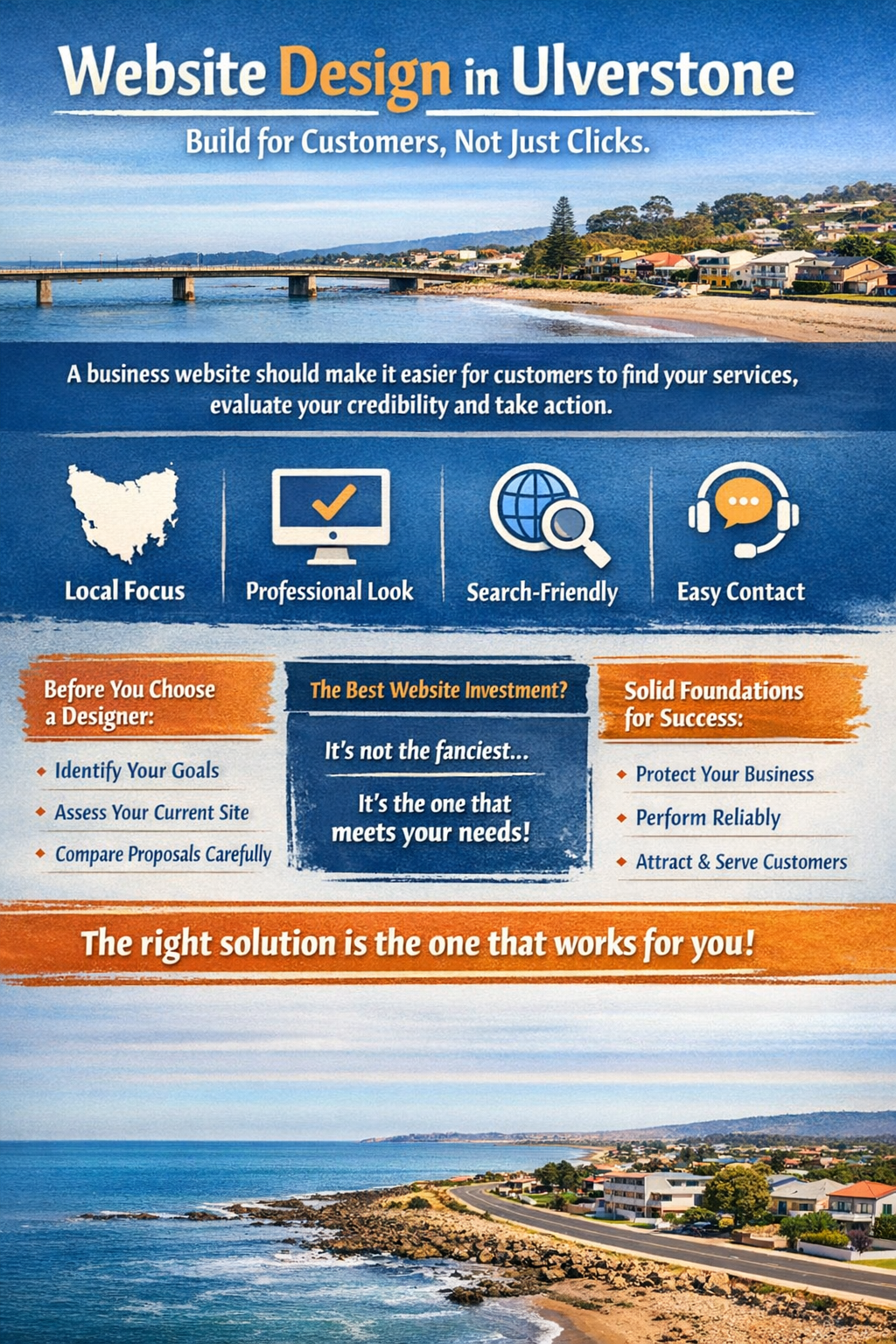
A business website should make it easier for customers to find your services, evaluate your credibility and take action.
For businesses in Ulverstone and the surrounding Central Coast of Tasmania, this means combining genuine local relevance with professional presentation, search-friendly content, reliable technical performance and straightforward customer contact options.
Before choosing a designer, identify your business goals, assess your current website and compare written proposals against clear requirements.
The best website investment isn’t necessarily the most elaborate.
It’s the solution that meets your needs, protects your business assets and creates a practical foundation for attracting and serving customers.
Professional Website Design in Ulverstone and North West Tasmania
VanBlaisa Pty Ltd is an Australian technology and digital services company based in West Ulverstone.
We provide professional website design, SEO, digital marketing and website support services, helping businesses build a stronger and more useful online presence.
Whether you’re starting a new business, improving an existing website or considering a redesign, we can help you identify the requirements and develop an appropriate solution.
Explore our services: Website Design Services for Small Businesses
View our projects: VanBlaisa Website Design Case Studies
Request a quote: Contact VanBlaisa
Phone: 0498 825 105
Email: admin@vanblaisa.com
VanBlaisa Pty Ltd — Website Design, SEO and Digital Technology. West Ulverstone, Tasmania, Australia.