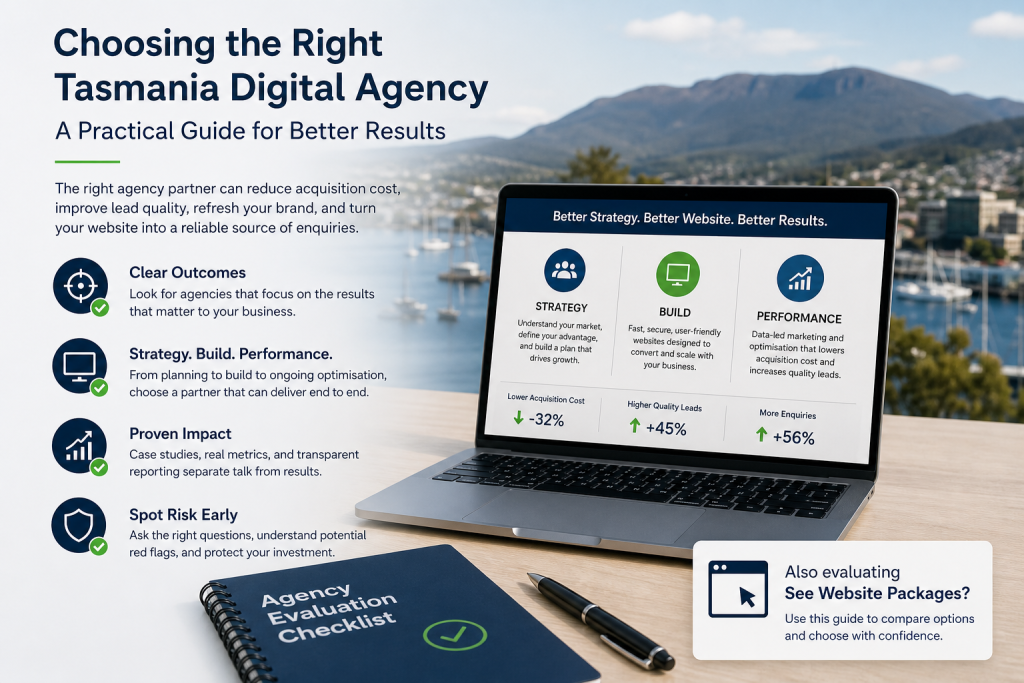
Buying Tasmania digital agency services is rarely about “more marketing” or “a new website” on its own. Most decision-makers are trying to reduce acquisition cost, improve lead quality, refresh a brand, or fix a site that looks fine but doesn’t generate enquiries. The problem is that many providers sound similar, while the results can be very different. This guide gives you a clear way to compare agencies, spot risk early, and choose a partner that can deliver across strategy, build, and performance. This may also be useful if you are evaluating See Website Packages.
What Tasmania digital agency services Means in Practice
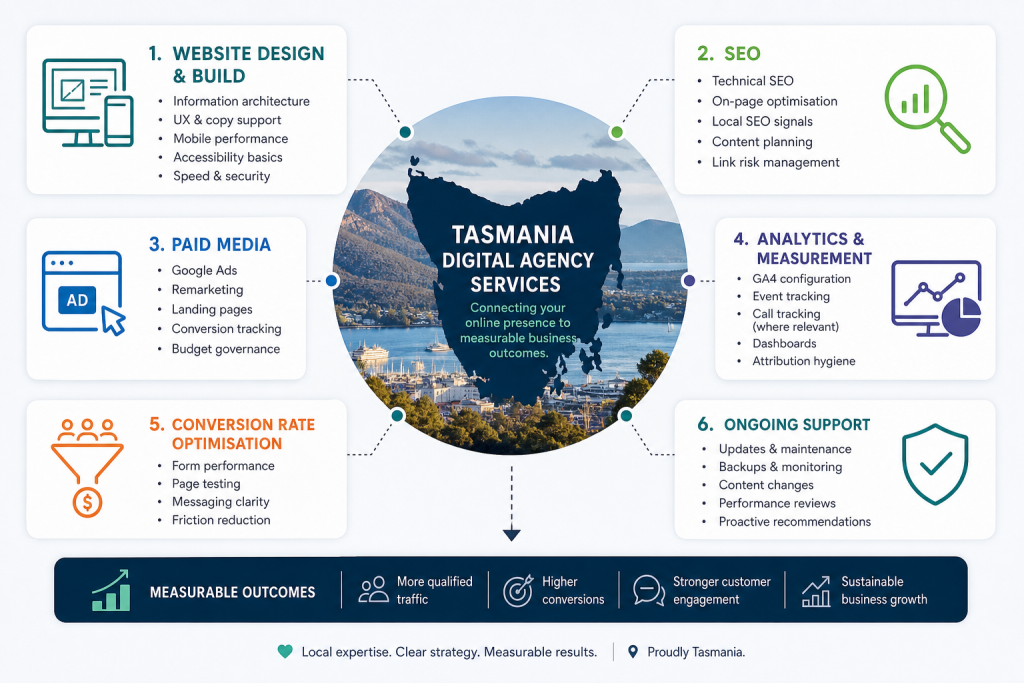
In practical terms, Tasmania digital agency services combine the essentials that connect your online presence to measurable business outcomes. For most small to mid-sized organisations, that typically includes:
- Website design and build (information architecture, UX, copy support, mobile performance, accessibility basics, speed, security)
- SEO (technical SEO, on-page optimisation, local SEO signals, content planning, link risk management)
- Paid media (Google Ads, rGOCSPX-UJzNKMsAMseOAWSqRYipmcnOZ3dIemarketing, landing pages, conversion tracking, budget governance)
- Analytics and measurement (GA4 configuration, event tracking, call tracking where relevant, dashboards, attribution hygiene)
- Conversion rate optimisation (form performance, page testing, messaging clarity, friction reduction)
- Ongoing support (updates, backups, monitoring, content changes, performance reviews)
Why It Matters
Agency selection affects revenue, operations, and risk. The right partner reduces waste and makes performance more predictable. The wrong partner creates rework, missed opportunities, and reporting you can’t rely on.
- Revenue impact: Clearer conversion paths and better lead qualification can reduce cost per acquisition and improve sales efficiency.
- Brand risk: Poor UX, broken tracking, or inconsistent messaging undermines credibility—especially for professional services, trades, and local operators where trust drives enquiries.
- Opportunity cost: A slow or unstable website, weak SEO foundations, or mismanaged ad accounts can stall growth for months.
- Governance: Ownership of domains, hosting, analytics, and ad accounts determines how easily you can change providers without disruption.
If you operate across Tasmania and interstate, consistency becomes even more valuable: one measurement approach, a repeatable landing page framework, and a scalable content structure reduce fragmentation as you expand service areas.
See Website Packages.
What to Look For
Use the criteria below to evaluate agencies with less guesswork and more commercial clarity.
1) Evidence of outcomes, not just aesthetics
Ask for examples that show the starting point, what changed, and what improved. A portfolio of attractive sites is not proof of performance. Look for:
- Conversion improvements (form submissions, calls, quote requests)
- Lead quality indicators (sales acceptance rate, reduced junk leads)
- SEO outcomes tied to intent (service pages ranking for buyer terms, not only blog traffic)
- Paid media efficiency (cost per lead, conversion rate, impression share where relevant)
2) Clear scope boundaries and deliverables
Ambiguity is where budgets and timelines blow out. A credible provider will specify:
- Number and type of pages, templates, and revisions
- Who supplies copy and images, and what happens if inputs are late
- Technical inclusions (speed targets, security, backups, staging environment)
- SEO inclusions (redirect mapping, metadata, schema basics, indexation checks)
- Tracking inclusions (GA4 events, conversion setup, call tracking if needed)
3) Ownership and access (non-negotiable)
You should retain admin access and ownership of:
- Domain registrar account
- Hosting (or at minimum, full access and a documented migration path)
- Google Analytics and Google Tag Manager
- Google Search Console
- Google Ads account (if running ads)
If an agency insists on owning these assets “for convenience,” treat it as a risk signal.
4) A conversion-first approach to website design
For commercial websites, design should follow decision paths: what a visitor needs to see to take the next step. Evaluate whether the agency talks about:
- Service page structure aligned to search intent
- Trust elements (proof, process, guarantees, compliance, reviews)
- CTA placement and friction reduction (forms, click-to-call, booking)
- Mobile-first performance and accessibility basics
If your priority is a fast, credible site that generates enquiries, review the Basic Website Design option and compare inclusions against other proposals.
5) Reporting that supports decisions
Good reporting answers: “What happened, why, and what we will do next.” Look for:
- Agreed KPIs tied to business outcomes (leads, calls, bookings, revenue proxies)
- Data quality checks (spam filtering, conversion validation)
- Actionable insights, not screenshots
- Monthly or fortnightly cadence depending on spend and volatility
6) Local relevance without local gimmicks
Local knowledge should show up in practical ways: service-area targeting, realistic competition benchmarks, and messaging that matches how customers in your region search and buy. Avoid providers who lean on location as a substitute for process, proof, and accountability.
What a Good Process Looks Like
A reliable agency process reduces risk, shortens time-to-value, and prevents scope drift. A strong engagement typically follows these steps.
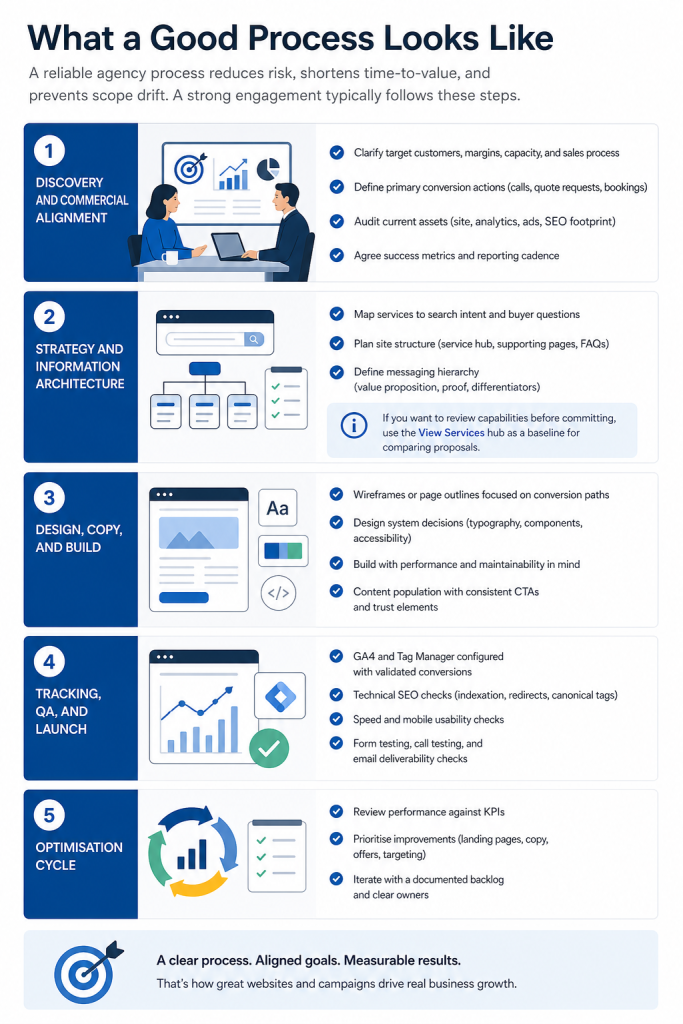
Step 1: Discovery and commercial alignment
- Clarify target customers, margins, capacity, and sales process
- Define primary conversion actions (calls, quote requests, bookings)
- Audit current assets (site, analytics, ads, SEO footprint)
- Agree success metrics and reporting cadence
Step 2: Strategy and information architecture
- Map services to search intent and buyer questions
- Plan site structure (service hub, supporting pages, FAQs)
- Define messaging hierarchy (value proposition, proof, differentiators)
If you want to review capabilities before committing, use the View Services hub as a baseline for comparing proposals.
Step 3: Design, copy, and build
- Wireframes or page outlines focused on conversion paths
- Design system decisions (typography, components, accessibility)
- Build with performance and maintainability in mind
- Content population with consistent CTAs and trust elements
Step 4: Tracking, QA, and launch
- GA4 and Tag Manager configured with validated conversions
- Technical SEO checks (indexation, redirects, canonical tags)
- Speed and mobile usability checks
- Form testing, call testing, and email deliverability checks
Step 5: Optimisation cycle
- Review performance against KPIs
- Prioritise improvements (landing pages, copy, offers, targeting)
- Iterate with a documented backlog and clear owners
Common Mistakes to Avoid
- Choosing on price alone: Low-cost builds often exclude tracking, SEO foundations, and conversion design—then require a second rebuild.
- Accepting vague deliverables: If “SEO included” is not defined, assume it is minimal.
- Not validating measurement: If conversions are not tested end-to-end, performance decisions become guesswork.
- Letting the agency own critical accounts: Loss of access creates lock-in and migration risk.
- Overbuilding before proving demand: For many businesses, a focused Basic Website Design plus strong tracking and a small set of high-intent pages outperforms a large brochure site.
- Ignoring operational capacity: If calls aren’t answered or leads aren’t followed up quickly, extra enquiries can waste spend and damage customer experience.
- Confusing activity with progress: More posts, more pages, or more “optimisations” don’t matter without KPI movement.
What Good Outcomes Look Like
Strong outcomes are specific, measurable, and tied to your sales process. Depending on your sector and starting point, realistic markers include:
- Higher conversion rate: More enquiries from the same traffic volume due to clearer messaging, better CTAs, and reduced friction.
- Improved lead quality: Fewer irrelevant enquiries because service pages set expectations and qualify prospects.
- Better visibility for buyer-intent searches: Service pages ranking for terms that indicate readiness to purchase, not only informational queries.
- Lower cost per lead: Paid campaigns supported by dedicated landing pages and validated conversion tracking.
- Operational clarity: Dashboards and reporting that show what is working, what is not, and what will be changed next.
- Reduced platform risk: A secure, maintainable website with documented access and ownership.
Frequently Asked Questions
How do I compare Tasmania digital agency services when proposals look similar?
Compare governance (who owns accounts), measurement (how conversions are validated), and deliverables (what is included and excluded). Then look for evidence of outcomes: baseline metrics, changes made, and results tied to leads or sales.
Should I hire a local Tasmania agency or a mainland provider?
Choose based on execution quality and accountability. Local knowledge can help with service-area targeting and regional competition, but it should sit alongside strong process, transparent reporting, and proven delivery.
What should be included in a basic website design package for a small business?
At minimum: mobile-first design, fast performance, clear service pages, conversion-focused CTAs, secure hosting setup, basic on-page SEO, and validated enquiry tracking. If those elements are missing, the site may look fine but underperform commercially.
How long does it take to see results?
Timelines depend on your starting point and channel mix. A website rebuild can improve conversion performance as soon as it launches (once tracking is validated). SEO typically takes longer because rankings and crawl signals build over time. Paid campaigns can generate leads quickly, but only if landing pages and conversion tracking are set up properly.
What questions should I ask before signing an agency contract?
Ask who owns the domain, hosting, analytics, and ad accounts; what KPIs will be reported; what deliverables are included; what the change-request process is; and how performance issues will be diagnosed and resolved.
Do I need ongoing support after the website goes live?
Yes, if you want reliability and performance. Ongoing support covers updates, security, backups, content changes, and optimisation based on real user behaviour and lead data.
What is a reasonable budget range for digital agency services?
Budget varies widely based on scope, timelines, and whether you need ongoing SEO or paid media management. The most reliable way to compare is to line up deliverables (pages, tracking, SEO foundations, support) and confirm what is excluded, then assess value against expected lead volume and sales capacity.
Next Steps
Start by clarifying your commercial goal (more qualified leads, lower acquisition cost, improved conversion rate, or a credible rebuild) and your constraints (timeline, internal resources, and budget). Then shortlist providers using the criteria above and insist on clear deliverables, ownership, and validated measurement.
If you want a practical, conversion-first path, review VanBlaisa Website Design & Digital Marketing and compare the Basic Website Design option against your requirements. To discuss fit and scope, book a consult with VanBlaisa Website Design & Digital Marketing by calling 0498825105 or emailing commerce258@gmail.com. You can also Request a Quote when you are ready to price your project.