Website Design in Latrobe, Tasmania: Authentic Websites That Generate Enquiries
Looking for professional website design in Latrobe, Tasmania? The right website should do more than look impressive. It should help local customers discover your business, understand why they should choose you, and take action—whether that means calling, requesting a quote, making a booking or purchasing online.
For small businesses in Latrobe and surrounding North West Tasmanian communities, an effective website combines five essentials: authentic branding, local search visibility, fast mobile performance, clear conversion pathways and measurable results.
At VanBlaisa Website Design & Digital Marketing, we believe a business website should be an asset that contributes to growth—not simply an online brochure.
This guide explains what to look for when choosing a Latrobe website designer, which features matter most, what questions to ask before investing, and how to measure whether your website is delivering genuine commercial value.
What Makes an Authentic, Top-Ranking Website That Creates Action?

An authentic, high-performing website accurately represents your business, makes your services easy to discover through search engines, and helps potential customers confidently take the next step.
The phrase “authentic, top-ranking websites that create action” describes three connected objectives:
Authenticity: Your website communicates your real expertise, services, reputation and brand personality rather than relying on generic templates and exaggerated promises.
Search visibility: Search engine optimisation (SEO) makes relevant pages easier for Google and other search platforms to discover, understand and potentially recommend.
Customer action: Conversion-focused design helps turn relevant visitors into genuine enquiries, appointments, bookings and sales.
No legitimate website designer can guarantee first place in Google. Rankings depend on competition, search intent, relevance, website quality and numerous other factors.
A better objective is to build a website that earns relevant visibility and turns that visibility into measurable business outcomes.
For a broader introduction, read our guide to website design in Tasmania and how it can support business growth.
Why Website Design Matters for Businesses in Latrobe, Tasmania
Latrobe, on Tasmania’s North West Coast, is home to businesses serving local residents, nearby communities and visitors exploring the region.
A business may operate primarily in Latrobe while also serving customers from Port Sorell, Shearwater, Railton, Devonport or Ulverstone. Its website needs to communicate these service areas accurately and make relevant services easy to find.
Consider three examples:
A local tradesperson needs potential customers to find specific services, confirm the areas covered and request a quote quickly.
A café or accommodation operator benefits from mobile-friendly menus, genuine photographs, opening information and straightforward booking or enquiry options.
An appointment-based professional service needs clear explanations, credible qualifications, accessible contact information and convenient appointment requests.
These businesses have different goals. A generic website design package that treats every business identically may not address their actual customer journeys.
Effective website design begins by understanding who your customers are, what they search for and what they need before making a decision.
Local relevance is more important than repeating location keywords
Local SEO is not about adding “Latrobe” to every heading or creating dozens of nearly identical suburb pages.
A stronger approach uses genuine information about where your business operates, which services it provides and how customers can engage with it.
For example, a business servicing Latrobe and Port Sorell should clearly explain its service coverage. It should not pretend to have separate physical offices in every town.
This approach supports customer trust, helps search engines interpret geographic relevance and makes your content more useful.
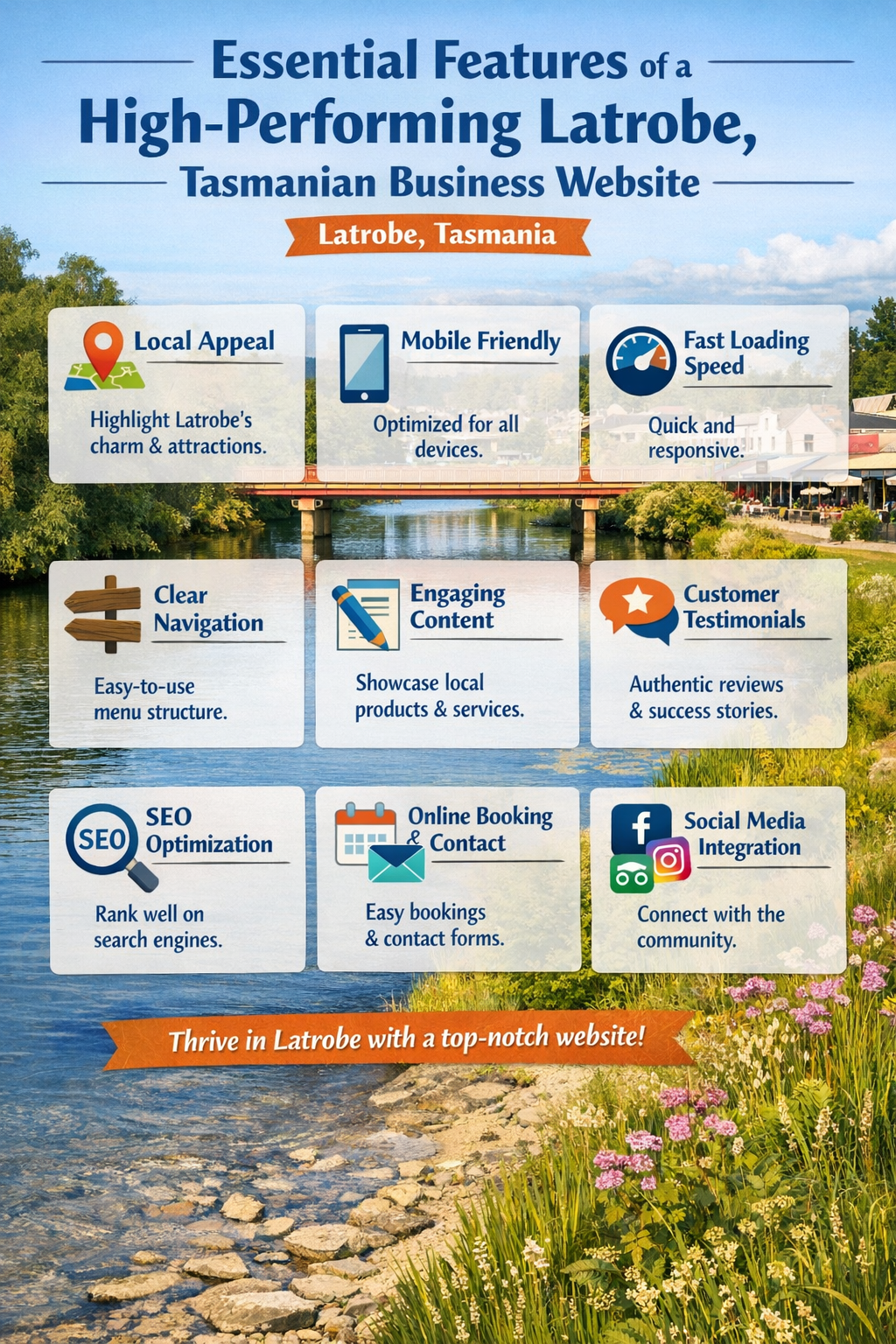
7 Essential Features of a High-Performing Latrobe Business Website
1. Clear Business Goals and Measurable Results
Before discussing colours, layouts or software, establish what your website needs to achieve.
A successful website design project begins with measurable business objectives.
| Business objective | Website feature | Key performance indicator |
|---|---|---|
| Generate enquiries | Quote forms and prominent contact options | Qualified enquiries per month |
| Increase phone calls | Click-to-call buttons | Website-originated calls |
| Secure appointments | Online booking integration | Confirmed bookings |
| Sell products | Streamlined e-commerce checkout | Orders and conversion rate |
| Improve local visibility | Service pages and local SEO | Relevant organic clicks |
| Build trust | Reviews, credentials and case studies | Enquiry and conversion rates |
Practical tip: Identify one primary conversion goal and two secondary goals before approving a proposal.
A website designed primarily for bookings should not use the same conversion structure as an online store.
Analytics should distinguish real business outcomes from superficial metrics such as page views alone.
2. Mobile-First Design and Fast Loading
Many local searches happen on smartphones, where visitors expect to find information quickly and interact without frustration.
A mobile-friendly business website should provide:
Readable text without zooming.
Easy-to-tap phone numbers and buttons.
Navigation that works on smaller screens.
Appropriately sized, compressed images.
Contact and booking options that are easy to locate.
Forms that are simple to complete on a phone.
Google measures aspects of website experience through Core Web Vitals.
Its recommended thresholds include:
| Performance metric | Good performance target |
|---|---|
| Largest Contentful Paint (LCP) | 2.5 seconds or less |
| Interaction to Next Paint (INP) | 200 milliseconds or less |
| Cumulative Layout Shift (CLS) | 0.1 or less |
These measure loading performance, responsiveness and visual stability respectively.
You can learn more from Google’s Core Web Vitals documentation and evaluate individual pages using PageSpeed Insights.
Speed alone will not guarantee higher search rankings, but faster, more usable pages provide a better foundation for customer engagement.
For a more detailed explanation, see why mobile-first website design matters for businesses.
3. Search Engine Optimisation Built into the Website
SEO should be considered during website planning—not added as an afterthought once development is finished.
A properly structured website helps search engines understand your business, its services and the relationship between individual pages.
Important SEO foundations include:
Descriptive page titles and meta descriptions.
Logical heading structures.
Individual pages for important services.
Relevant, original and helpful written content.
Clean, readable URLs
Internal links connecting related information.
Descriptive image alternative text.
Correct canonical URLs and indexing settings.
XML sitemap configuration.
Structured data where appropriate.
For a Latrobe business, these elements should be aligned with actual customer searches.
For example, a landscaping business may need separate pages explaining garden maintenance, lawn care and landscaping services.
Each page should answer a distinct customer need rather than repeating the same generic description.
Ask your website designer: Does the quote include keyword research, content planning, technical SEO, analytics and indexing checks—or only basic page titles?
Those deliverables can make a substantial difference to what you receive.
4. Local SEO and Google Business Profile Integration
Local SEO helps relevant customers discover businesses through geographically related searches.
A well-planned local search strategy may include:
Google Business Profile: For eligible businesses, the profile should contain accurate business details, suitable categories, opening hours, services, contact information and genuine photographs.
Consistent business details: Business names, phone numbers, addresses where applicable, and website information should be accurate across relevant directories and online listings.
Location-specific content: Describe the communities your business genuinely serves, and create separate location pages only when they provide meaningful, unique information.
Local business structured data: Appropriate Schema.org markup can clarify business information, provided it accurately reflects the business and does not imply nonexistent locations.
Customer reviews: Genuine feedback provides useful social proof and helps prospective customers evaluate your reputation.
Relevant local links: Relationships with appropriate business associations, community organisations and other credible websites may contribute to online visibility.
Businesses operating entirely online are not automatically eligible for a Google Business Profile. Always follow Google’s official Business Profile guidelines.
For an initial assessment of your online visibility, explore the VanBlaisa Intelligence Engine local visibility scanner.
5. Conversion-Focused Website Design
Attracting visitors is only part of the equation.
A website also needs to help people understand your offer and make their next decision easy.
Conversion-focused design addresses questions such as:
What does this business offer?
Is the service relevant to my needs?
Does the company service my location?
Why should I trust this provider?
What should I do next?
The answers should be available without excessive searching.
Calls to action that encourage meaningful engagement
Effective calls to action are specific and relevant to the page.
For example:
“Request a Free Quote”
“Book an Appointment”
“Call Our Team”
“Check Availability”
“Explore Our Services”
The best choice depends on your business model and the customer’s stage in the buying journey.
A plumbing service page may benefit from an immediately visible call button, while an accommodation website may need a prominent availability or booking function.
Keep enquiry forms straightforward. Ask only for information necessary to respond effectively, then collect additional details when appropriate.
Customer testimonials, relevant credentials, project examples and genuine business photographs can also help people make confident decisions.
Read our guide to conversion-focused website design strategies for a deeper explanation of how design decisions influence business results.
6. A Website You Can Maintain and Control
Your website should remain useful long after the initial launch.
Before engaging a web designer, establish who controls the essential business assets.
These include:
Domain registration and DNS management.
Website content and original creative assets.
Hosting and backup arrangements.
Content management system access.
Google Analytics and Search Console accounts.
Customer enquiry data.
Website integrations and relevant licences.
WordPress can be a practical choice for businesses wanting a flexible content management system with a broad ecosystem of commercial tools.
Other platforms may be suitable depending on the project’s complexity, integrations and maintenance requirements.
The key consideration is not simply which platform is fashionable.
It is whether the platform meets your business requirements without imposing unnecessary costs, technical limitations or vendor lock-in.
Ask whether you can update services, opening hours, prices, photographs and basic content without paying a developer for every change.
Also confirm what happens to your website, data and licences if you change providers.
7. Reliable Hosting, Security and Ongoing Support
Launching a website is an important milestone, but it does not eliminate the need for maintenance.
Websites require monitoring, security updates, backups and periodic improvements.
Your website proposal should explain:
Who maintains the website and its software.
How frequently backups are performed.
Whether backup restoration is tested.
Which security protections are included.
What support arrangements apply.
Whether website performance is monitored.
How urgent faults are handled.
What maintenance costs after launch.
An effective support arrangement should be appropriate to the website’s complexity and commercial importance.
For example, an e-commerce business processing daily orders may have different operational needs from a small informational website.
A good website partner will explain those differences rather than recommending the same support arrangement to every business.
How Much Does Website Design Cost in Latrobe?
The cost of professional website design in Latrobe depends on what the business needs, the amount of work involved and the level of ongoing service.
A straightforward business website will generally involve less development than a large e-commerce store or a site requiring advanced integrations.
Important pricing factors include:
| Cost factor | Why it matters |
|---|---|
| Number of pages | More unique content and layouts require additional work |
| Custom design | Bespoke layouts and branding increase design requirements |
| Copywriting | Professional content requires research and preparation |
| SEO | Research, page architecture and technical optimisation add scope |
| E-commerce | Products, payments, shipping and checkout increase complexity |
| Booking systems | Scheduling and workflow integration require configuration |
| Hosting and maintenance | Ongoing infrastructure and support create recurring costs |
| Integrations | CRM, automation and external software may add setup and licence fees |
One-off website builds versus monthly website packages
Some website designers charge a fixed project fee, while others offer ongoing monthly arrangements that may combine development, hosting, maintenance and marketing services.
Neither model is automatically better.
A one-off build may suit businesses with established internal resources. A managed service may suit owners who want continuing technical support and ongoing improvements.
Compare the total cost over 12 to 24 months, not just the initial advertised amount.
Also clarify what happens if an ongoing arrangement ends, including ownership of the finished website and whether transfer costs apply.
VanBlaisa offers website design services for small businesses with different options depending on business requirements.
The most useful starting point is a clear scope and quote based on the outcomes your business needs.
How to Choose the Right Website Designer in Latrobe
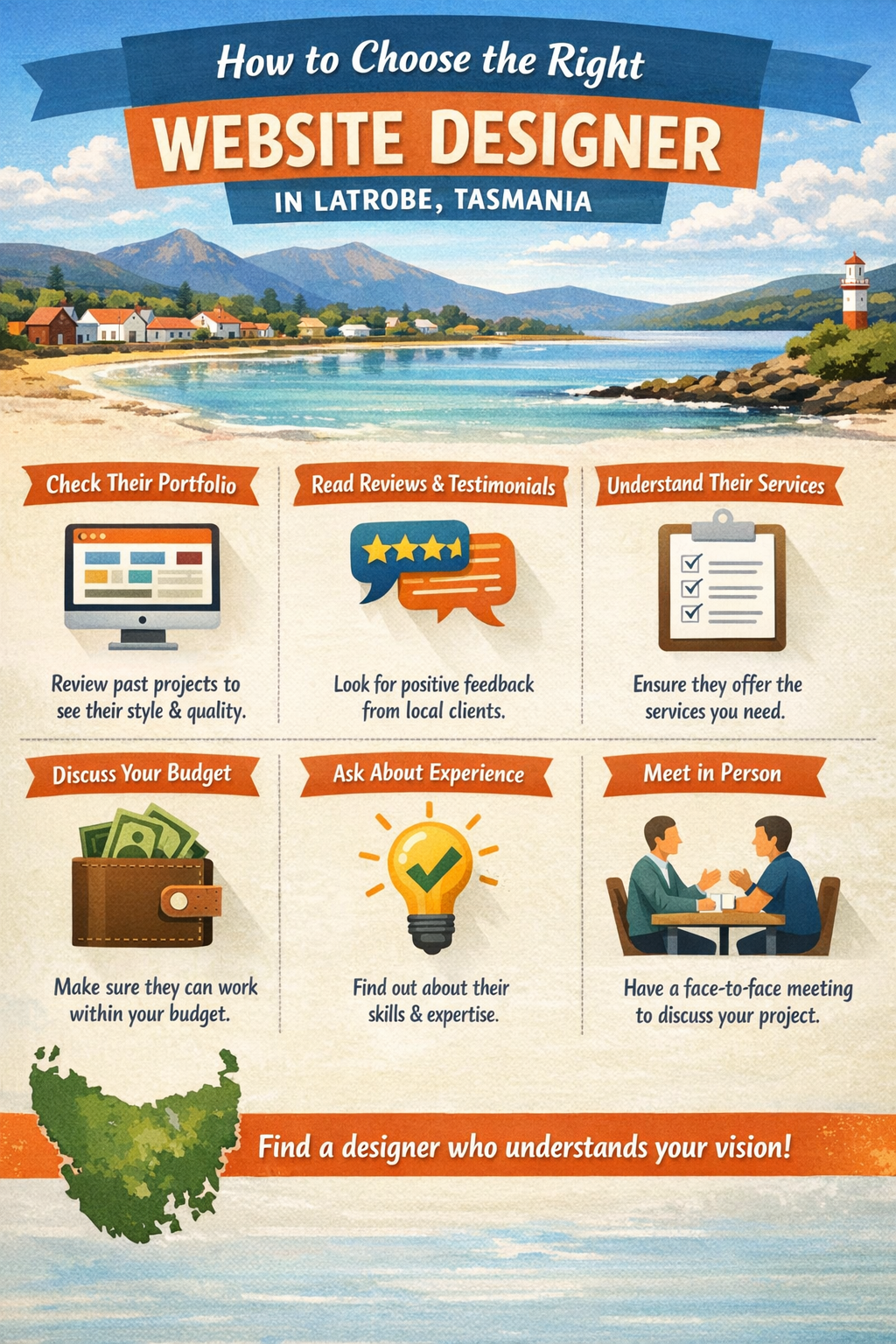
Finding the right web design partner requires more than comparing homepage screenshots.
A strong portfolio should be supported by a transparent process, relevant technical capability and evidence that the designer understands how businesses acquire customers.
Questions to Ask Before Hiring a Website Designer
Use these questions during discovery calls or when comparing proposals.
Can you show live examples of websites you have built? Review their performance, navigation, content quality and mobile experience.
How do you approach SEO before development begins? Ask how search intent, keywords, service pages and website structure influence the design.
What will you measure after launch? Look for a clear approach to enquiries, bookings, sales and relevant search traffic.
How will you represent my business authentically? Ask about original content, genuine imagery, branding and customer research.
Which content management system will you use, and why? The recommendation should match your requirements rather than the agency’s convenience alone.
What exactly is included in the quote? Clarify design, content, SEO, hosting, security, revisions, integrations and launch testing.
Who owns the website and associated accounts? Ensure ownership, administrative access and exit arrangements are documented.
What happens after launch? Request details of support, maintenance, reporting and the process for improving results.
A capable designer should be able to explain these matters in plain language, without relying on vague promises.
For additional advice, see our article on choosing the right website design firm.
A Practical Website Designer Comparison Checklist
| Evaluation criterion | What to look for |
|---|---|
| Local market understanding | Genuine knowledge of your customers and service areas |
| Portfolio | Relevant live projects with clear business objectives |
| Technical capability | Mobile usability, security, performance and accessibility |
| SEO experience | Search-led structure, content and technical fundamentals |
| Conversion strategy | Clear enquiry paths and measurable actions |
| Transparency | Written scope, pricing, exclusions and ownership arrangements |
| Support | Defined responsibilities and ongoing service options |
Do not assume the cheapest proposal represents the lowest overall cost.
An inexpensive website that requires substantial redevelopment or fails to support customer enquiries may become a more costly investment over time.
Equally, paying more does not automatically produce better results.
Choose the provider whose proposed solution is justified by your business needs and supported by credible evidence.
Website Design Examples: What Does a Good Project Look Like?
When reviewing a website designer’s previous work, examine the decisions behind each project.
At VanBlaisa, our published website design case studies feature projects including O’Dea Lawyers, Awkar & Co and NSA Conveyancing.
These projects illustrate several important principles.
O’Dea Lawyers: Service-focused website organisation, clearer enquiry pathways and improvements to content structure supporting search visibility.
Awkar & Co: A website rebuild focused on service architecture, mobile-friendly presentation and conversion-oriented contact pathways.
NSA Conveyancing: Search-friendly content organisation, internal linking and service pages designed to help visitors locate relevant information.
These examples demonstrate the types of design and technical work worth evaluating.
When comparing any designer, ask for the project’s objectives, changes implemented and measured outcomes where available. Design features alone should not be mistaken for independently verified revenue or ranking improvements.
Why Local Businesses Choose VanBlaisa for Website Design
Client reviews
"Has seen my business grow daily..."
VanBlaisa Website Design & Digital Marketing is based on Tasmania’s North West Coast and provides website design, SEO and digital services to businesses throughout Tasmania and Australia.
We approach website development as a combination of design, technical performance, search visibility and business outcomes.
Our services encompass:
Custom, mobile-first website design.
Search-friendly website architecture.
Local SEO and on-page optimisation.
Conversion-focused landing pages.
E-commerce and business integrations.
Website hosting, maintenance and support.
Analytics and ongoing website improvements.
Rather than designing pages in isolation, we consider how customers find your business, evaluate your services and decide to contact you.
You can learn more about our background and approach on the About VanBlaisa page.
What Happens After Your New Website Launches?
A website should be evaluated against the objectives established at the beginning of the project.
A practical 90-day post-launch plan provides an opportunity to identify technical problems and improve performance.
First 30 Days: Validate the Foundations
Confirm that important pages are indexable, contact forms work, mobile layouts display correctly and analytics events are recording accurately.
Test website performance, inspect Search Console for technical issues and confirm that business information is consistent.
Days 31–60: Review Visitor Behaviour
Examine which pages attract relevant traffic, where visitors engage and whether contact pathways are producing enquiries.
Identify pages with unclear messaging or unnecessary friction.
Prioritise changes that are likely to improve meaningful customer actions.
Days 61–90: Refine and Improve
Review early trends, refine calls to action and improve priority content where evidence supports changes.
For businesses targeting multiple service areas, assess whether additional original, genuinely useful location content is warranted.
Continue reviewing performance over time. Organic search visibility may take longer than 90 days to develop, particularly for competitive searches or new websites.
The objective is continuous, evidence-led improvement—not redesigning a website whenever its appearance becomes familiar.
Frequently Asked Questions About Website Design in Latrobe
Who provides website design services in Latrobe, Tasmania?
VanBlaisa provides website design and digital marketing services to businesses in Latrobe and across Tasmania. Based on the North West Coast, the business offers website development, SEO, hosting and ongoing support. You can contact VanBlaisa to discuss a project.
How much does a small business website cost in Latrobe?
Pricing depends on the number of pages, custom functionality, content, SEO requirements and ongoing support. Request an itemised proposal explaining both upfront and recurring costs. Compare ownership and maintenance arrangements as well as the initial price.
Can a website help my Latrobe business appear in Google search results?
Yes. A well-structured, indexable website with useful service content and appropriate local SEO can improve its ability to compete for relevant searches. However, no designer can guarantee a particular ranking, and results depend on competition, relevance and ongoing optimisation.
Is local SEO different from ordinary website SEO?
Local SEO focuses on geographic relevance and customers searching for businesses serving particular areas. It can involve location-specific website content, accurate business listings, eligible Google Business Profiles and local reputation signals. Traditional SEO also covers site structure, content quality, performance and technical accessibility.
Do I need separate pages for Latrobe, Devonport and Port Sorell?
Not necessarily. Separate location pages are useful when each contains substantial, unique information relevant to that community. Duplicating almost identical pages and swapping town names provides little value. Begin with accurate service-area information and create additional pages only where they genuinely help customers.
Is WordPress suitable for a small business website?
WordPress is a flexible option for many small businesses, particularly those needing service pages, blog content, e-commerce or regular updates. The right choice still depends on performance needs, budget, security, maintenance and integrations.
How long does professional website design take?
Project duration depends on design complexity, the amount of content, required integrations and client approvals. A straightforward business website can often be delivered within several weeks, while more complex projects require additional planning and development. Request a project-specific timeline before committing.
How can I tell whether my website is generating results?
Track meaningful outcomes such as qualified enquiries, website-originated calls, booking requests, completed purchases and organic search traffic. Google Analytics 4 and Google Search Console can help assess website performance when configured appropriately. Compare results against your pre-launch baseline.
Ready for a Website That Works Harder for Your Latrobe Business?
Your website should make it easier for potential customers to discover your services, trust your business and take action.
Whether you’re establishing a new business in Latrobe, improving an existing website or planning a complete redesign, the right approach begins with clear goals and a practical plan.
VanBlaisa Website Design & Digital Marketing can help you assess your requirements and explore a website designed around real business outcomes.
Start by discussing your business, the customers you want to attract and the results you want your website to deliver.
Request a website design quote: Contact VanBlaisa
Call: 0498 825 105
Email: admin@vanblaisa.com
Explore our services: Website Design Services for Small Businesses
Serving businesses in Latrobe, North West Tasmania and throughout Australia.